
If your bathroom walls are starting to look tired, you’re not alone. Bathrooms take a beating in Virginia—hot showers, daily moisture, and (in places like Virginia Beach and Norfolk) that coastal humidity that seems to hang around forever. One day the paint looks “fine,” and the next you’re noticing peeling near the ceiling, bubbling around the fan, or a dull, blotchy finish that never really looks clean.
A fresh coat of paint can make a bathroom feel brand new without a full remodel. But the big question we hear all the time is simple: what’s the real cost to paint a bathroom in Virginia in 2026? Homeowners in Chesapeake, Suffolk, Virginia Beach, and Norfolk want a number they can plan around without getting surprised later by “extra prep” charges or last-minute add-ons.
In this guide, we’ll walk you through realistic 2026 price ranges, what drives the cost up or down, what’s usually included (and what usually isn’t), and how to budget smart for a bathroom repaint in our area. We’ll also compare DIY vs hiring a pro in a fair way because sometimes DIY makes sense, and sometimes it turns into a frustrating redo.
At Showstopper Painting, our team paints bathrooms every week across Hampton Roads. We’ll keep this simple, practical, and local, so you can make a confident decision for your home.
Quick Answer: What Does It Cost To Paint A Bathroom In Virginia In 2026?
For most homeowners, the cost to paint a bathroom in Virginia in 2026 lands somewhere between $450 and $2,200.
That’s a wide range on purpose, because bathrooms vary more than almost any other room. A small powder room with solid walls and no ceiling stains is usually straightforward. But a full bath with a shower, high moisture, peeling paint, and lots of trim can take much longer than people expect. And in older Norfolk homes (or any home with past water issues), the prep work can be the difference between paint that lasts for years and paint that starts peeling again in a few months.
In general, your final price depends on three main things: how much surface area we’re painting, how much prep is needed, and what paint system is required to handle moisture. Bathrooms also have tight spaces, lots of cut-in work around fixtures, and ventilation issues that can slow down drying times especially during humid stretches in Virginia Beach and Chesapeake.
To make this easier, here are realistic ranges we commonly see for bathroom painting cost in Virginia Beach, Chesapeake, Norfolk, and Suffolk.
Table #1: Bathroom Painting Cost Ranges in Virginia (2026)
| Bathroom size/type | Typical scope | Estimated price range (low / typical / high) | Notes (what usually pushes it up) |
|---|---|---|---|
| Powder room (half bath) | Walls only | $450 / $650 / $950 | Heavy patching, dark-to-light color change, lots of tight cut-ins |
| Powder room (half bath) | Walls + trim/door | $650 / $900 / $1,250 | Detailed trim, older doors, glossy trim that needs extra prep |
| Small full bath | Walls only | $550 / $850 / $1,300 | Moisture damage near shower, peeling, stains that need primer |
| Small full bath | Walls + ceiling + trim/door | $850 / $1,250 / $1,800 | Ceiling stains, textured ceiling, weak ventilation, extra drying time |
| Standard full bath | Walls + ceiling | $900 / $1,350 / $1,950 | Vaulted areas, lots of cut-in around tile/vanity, patching |
| Standard full bath | Walls + ceiling + trim/door | $1,100 / $1,650 / $2,200 | Peeling paint, caulk failure, multiple doors/trim details |
| Large primary bath | Walls + ceiling | $1,200 / $1,800 / $2,600 | Higher ceilings, more wall area, separate toilet room |
| Large primary bath | Walls + ceiling + trim/doors | $1,500 / $2,300 / $3,200+ | Multiple doors, extensive trim, repairs, premium paint system |
These are “real life” ranges, not best-case-only numbers. If you’re trying to budget without stress, we usually tell homeowners to plan for the typical column first, then adjust up or down based on prep and scope.
What’s Included In A Professional Bathroom Paint Job (And What’s Not)
When you hire a professional bathroom painter, you’re not just paying for paint on the wall. You’re paying for a process that helps the finish look smooth, cure correctly, and hold up in a room that gets wet and steamy almost every day.
Here’s what’s typically included in a professional bathroom repaint with our team at Showstopper Painting.
We start with surface protection, because bathrooms have a lot of items close together. We protect floors, countertops, and fixtures, and we cover anything that could catch drips or dust from sanding. In a tight bathroom, this step matters more than people think, one small bump can smear paint on a vanity edge or leave dust in places you don’t want it.
Next comes prep, which is where a bathroom paint job is often won or lost. Prep can include light patching, sanding down rough spots, removing loose paint, and re-caulking small gaps where trim meets the wall. In humid rooms, caulk lines can crack or separate over time, and repainting without fixing those gaps can make the whole job look messy even if the color is great.
After prep, we handle priming when it’s needed. Primer isn’t always required on every bathroom repaint, but it’s very common in bathrooms with water stains, repaired drywall, glossy old paint, or areas where paint has peeled. Primer helps the new paint stick and helps block stains from bleeding through. If you’ve ever painted a bathroom and watched a yellowish ceiling stain “ghost” back through your new paint, you already know why primer matters.
Then we apply finish coats, usually two coats for solid coverage and a consistent sheen. Bathrooms are a place where sheen (how shiny the paint is) matters. Too flat and it can scuff and stain easily. Too glossy and it can highlight every bump and patch. We help homeowners choose a finish that’s practical for cleaning but still looks good in bathroom lighting.
Finally, we do cleanup and a final walkthrough. That includes removing coverings, cleaning up dust, and checking edges, cut lines, and coverage. Bathrooms have lots of corners and transitions around mirrors, light fixtures, towel bars, and tile lines, so a final detail check is a big part of a professional result.
Now, here’s what homeowners often assume is included, but usually isn’t included in a standard bathroom painting quote unless it’s clearly listed.
If there’s rotted trim, soft drywall, or active leaks, those are repair issues first, paint issues second. Paint can’t fix a moisture problem. If the bathroom fan doesn’t work well, or there’s a slow leak that keeps staining the ceiling, the best paint in the world won’t hold up long-term.
The same goes for heavy mold remediation. Small surface mildew can sometimes be cleaned and sealed as part of prep, but true mold problems need to be handled safely and correctly. If a bathroom in Suffolk or Chesapeake has ongoing ventilation issues and mold keeps returning, we’ll talk through the safest next step before we paint.
Also, most painting quotes don’t include replacing bathroom fans, moving plumbing fixtures, or major carpentry changes. We can absolutely coordinate around your plan, but those are separate scope items that should be discussed upfront so your estimate stays accurate.
The Biggest Factors That Change Bathroom Painting Cost In Virginia
Bathroom painting prices can look confusing because two bathrooms that “feel” the same size can take very different amounts of time. When we build a bathroom painting estimate in Suffolk, Chesapeake, Norfolk, or Virginia Beach, we’re mostly pricing the time it takes to prep and paint correctly, especially in a room that deals with moisture every day.
Here are the biggest factors that move the cost up or down, explained in plain English.
Bathroom Size And Layout
Size matters, but layout matters almost as much. A small bathroom with one door, one mirror, and a simple vanity can be quick. But a bathroom with lots of angles, a separate toilet nook, or tight spaces behind the door can slow everything down.
Even in a “small” bath, you can have a lot of cut-in work around towel bars, medicine cabinets, tile edges, and light fixtures. Cut-in work is the careful brushwork around edges, and it’s one of the most time-consuming parts of painting.
This is also where homeowners sometimes ask about bathroom paint cost per square foot. It can be helpful as a rough idea, but it’s not perfect for bathrooms because bathrooms have more detail per square foot than most rooms. A living room might have long, open walls. A bathroom might have short wall sections broken up by tile, mirrors, and plumbing.
Ceiling Height And Vaulted Ceilings
Most bathrooms have standard ceilings, but some primary baths have taller ceilings or vaulted areas. Higher ceilings mean more ladder work, more time cutting in, and more time keeping lines clean where the ceiling meets the walls.
Vaulted ceilings can also change drying time. Warm air and moisture rise, and in a bathroom with poor ventilation, that can make the ceiling area the “problem zone” for peeling and stains. If we’re addressing that, we may recommend a specific primer and paint system that costs more but holds up better.
Trim, Doors, And Cabinets (If Included)
A big price swing happens when homeowners decide whether they want walls only or walls + ceiling + trim/door. Trim and doors take longer than people expect because they need more detailed work and usually need extra prep.
Bathrooms often have glossy trim paint already. Glossy surfaces can be slick, and paint doesn’t love sticking to slick surfaces unless they’re cleaned and prepped correctly. That prep time is mostly labor, and labor is the biggest part of the cost.
Cabinets are another category. Some homeowners ask if we can “just paint the vanity while you’re in there.” Sometimes that makes sense, but it’s not the same as painting walls. Cabinets need a different prep process and often a different coating system. If you’re considering that, it’s usually better to treat it as a separate scope item and talk through options like our cabinet painting service: https://showstopperpainting.com/cabinet-painting/
Paint Type And Moisture Resistance (Simple Explanation)
Bathrooms need paint that can handle moisture and cleaning. That doesn’t always mean the most expensive paint on the shelf, but it does mean choosing the right product for the job.
In plain terms, bathroom paint needs to do three things well:
It needs to stick (good adhesion), because steam and condensation can push paint off the wall over time if the surface wasn’t prepped right.
It needs to resist moisture, because bathrooms get damp and then dry out again, over and over. That cycle can stress paint.
It needs to be washable, because bathrooms collect fingerprints, hair spray, makeup smudges, and everyday marks.
In coastal areas like Virginia Beach and parts of Norfolk, humidity can be a constant background issue, not just a “winter problem” or a “summer problem.” That’s why we often steer homeowners toward paint choices that hold up better in damp spaces, especially if the bathroom fan isn’t strong.
Condition Of Walls (Peeling, Stains, Or A Previous Bad Paint Job)
Wall condition is one of the biggest cost drivers. If the walls are clean and solid, painting is mostly straightforward. But if we’re dealing with peeling paint, bubbling, or rough patches, the job becomes more about prep than paint.
Peeling in bathrooms often happens because moisture got behind the paint film. That can come from poor ventilation, a leak, or paint that wasn’t designed for the space. If we paint right over peeling areas without addressing the cause and stabilizing the surface, the new paint can fail too.
Stains are another common issue especially on ceilings. Water stains can bleed through regular paint, even if you apply multiple coats. That’s why stain-blocking primer is sometimes needed, and that adds both material cost and labor time.
If the bathroom has a history of “quick fixes” (like patching without sanding, or painting over soap residue), we may need extra cleaning and sanding to get a smooth, lasting finish.
Humidity, Ventilation, And Coastal Considerations (Virginia Beach / Norfolk Angle)
This is where Virginia bathrooms are a little different than some other regions. In Hampton Roads, we deal with humid air for a big chunk of the year. In Virginia Beach and Norfolk especially, the coastal air can keep bathrooms feeling damp even when you’re not running the shower.
If a bathroom fan is weak, vented incorrectly, or not used regularly, moisture can sit on the walls and ceiling longer. That can lead to peeling, mildew, and that “always looks dingy” feeling.
From a pricing standpoint, ventilation issues can increase cost because we may need extra prep (like cleaning and sealing problem areas) and we may recommend a more protective paint system. It can also affect scheduling because high humidity can slow drying and curing.
If you want a deeper local read on how our climate affects paint performance, this article is helpful background: https://showstopperpainting.com/blog/how-virginia-beachs-coastal-climate-affects-your-homes-exterior-paint-and-how-to-combat-it/
(Exterior-focused, but the humidity and salt-air discussion applies to moisture and durability in general.)
Timeline And Urgency (Rush Jobs)
If you need the bathroom painted fast like before guests arrive, before listing your home, or before a move, your cost can go up.
Rush jobs sometimes require rearranging schedules, adding crew members, or working longer days to hit a deadline. Bathrooms also require dry time between coats, and while we can plan efficiently, there are limits to how much you can “speed up” a quality job without risking performance.
Occupied Home Logistics (Especially One-Bathroom Homes)
Logistics matter a lot in bathrooms. If your home has only one full bathroom, we have to plan around your family’s routine. That can mean working in tighter windows, coordinating when the room can be out of service, and making sure everything is protected and cleaned up at the end of each day.
These details don’t always show up in a simple “per square foot” price, but they do affect labor time. And again, labor time is the main driver of the bathroom repaint cost in Chesapeake, Suffolk, Virginia Beach, and Norfolk.
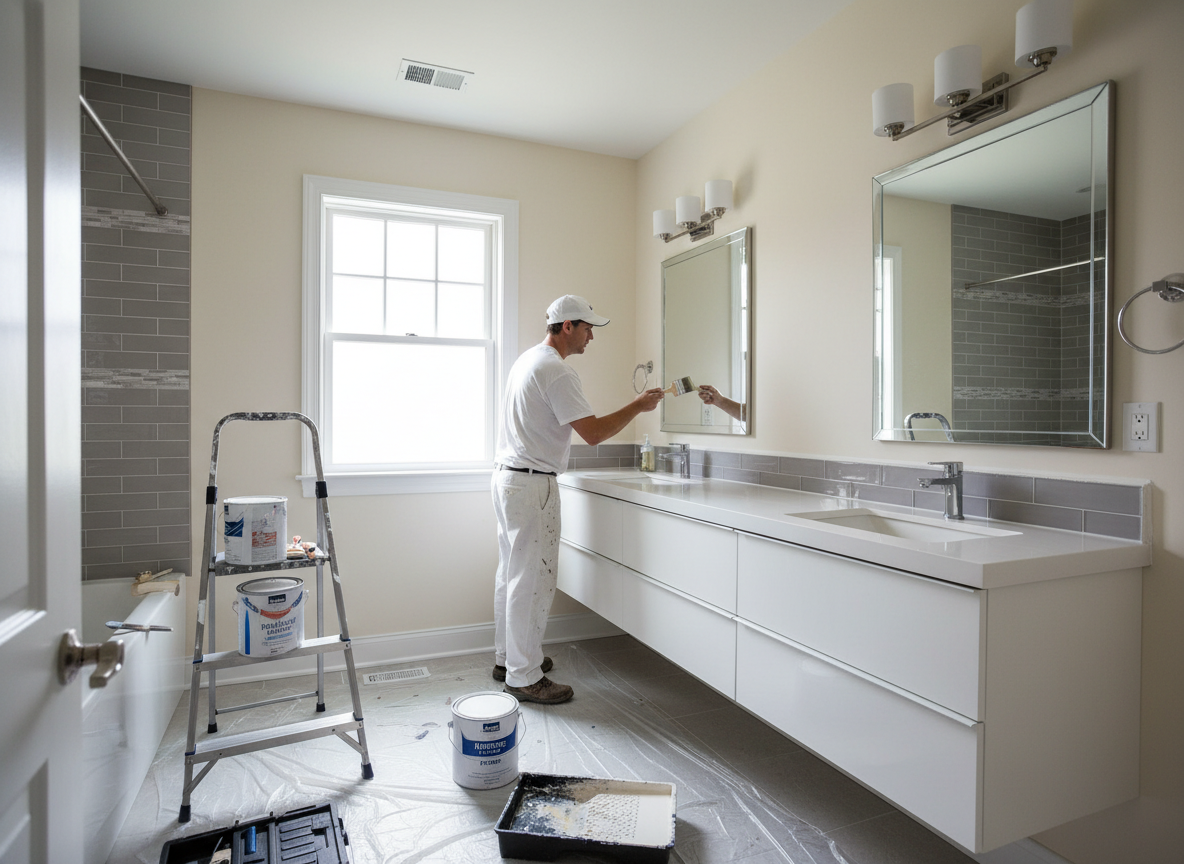
Labor Vs Materials: Where Your Money Actually Goes
Homeowners often assume paint is the expensive part. In reality, labor is usually the biggest cost in a professional bathroom paint job.
Paint and primer matter, but they’re a smaller slice of the total compared to the time it takes to prep, cut in around fixtures, and create a clean finish in a tight space. Bathrooms are detail-heavy rooms. There’s not much “rolling big open walls” like you’d have in a bedroom or living room.
Bathrooms also take longer because the prep tends to be more involved. Even if the bathroom looks “pretty good,” there’s often hidden work: cleaning off residue, sanding glossy areas, sealing small stains, and fixing caulk lines that have cracked from years of moisture.
Another reason labor is higher is the amount of careful brushwork. Around mirrors, tile edges, shower surrounds, vanities, and door trim, we’re doing a lot of slow, controlled painting. That’s what makes the finished job look sharp instead of sloppy.
Materials still matter, though. Bathrooms often need better primers and more durable paint finishes than low-moisture rooms. And if we’re using specialty products to block stains or improve adhesion, those costs can add up. But even then, the materials are usually not the main reason the price changes. The time and skill required is.
Table #2: Example Cost Breakdown (Typical Virginia Bathroom Repaint)
| Line item | What it means | Typical share of total cost |
|---|---|---|
| Protection & setup | Covering floors/vanity, taping, protecting fixtures | 5%–10% |
| Cleaning & surface prep | Degreasing, removing residue, light sanding | 10%–20% |
| Patching & sanding | Fixing small holes, smoothing rough areas | 10%–25% |
| Caulking | Sealing small gaps at trim and corners | 3%–8% |
| Priming (as needed) | Bonding primer, stain-blocking primer, spot priming | 5%–15% |
| Painting walls | Cutting in and rolling 2 coats | 20%–35% |
| Painting ceiling (if included) | Cutting in, rolling, dealing with stains/texture | 10%–20% |
| Painting trim/door (if included) | Detailed brushwork, extra prep on glossy trim | 10%–25% |
| Materials | Primer, paint, caulk, tape, plastic, sundries | 5%–12% |
| Cleanup & final walkthrough | Removing coverings, touch-ups, quality check | 5%–10% |
If you’re comparing quotes, this breakdown can help you spot what’s missing. A very low quote often means one of two things: either the scope is smaller than you think, or the prep steps are being skipped. In bathrooms, skipped prep tends to show up later as peeling, stains coming back, or a finish that looks uneven.
Diy Vs Hiring A Pro In A Virginia Bathroom: What’s Really Worth It?
DIY bathroom painting can work, especially in a small powder room with clean walls and no moisture issues. If you enjoy DIY projects and you’re patient with prep, you can get a nice result.
But bathrooms are also one of the easiest rooms to mess up, because moisture is unforgiving. The most common DIY bathroom failures we see in Virginia Beach and Norfolk are paint peeling near the ceiling, bubbling around the shower area, and patchy sheen that looks fine at night but looks streaky in daylight.
A big DIY pitfall is skipping primer when it’s needed. Another is choosing the wrong sheen. Flat paint hides bumps but doesn’t clean well. High-gloss cleans well but can highlight every patch and roller mark. Bathrooms usually need a balanced choice, and the “best” choice depends on the wall condition and how the bathroom is used.
Another common issue is not fixing the moisture source. If the fan is weak or the bathroom stays damp, paint becomes a band-aid. A pro won’t magically fix ventilation, but a good painter will point out what’s likely to cause early failure and recommend a paint system that gives you the best chance of long-term performance.
Hiring a professional bathroom painter in Norfolk, Chesapeake, Suffolk, or Virginia Beach is often worth it when you have peeling paint, stains, a textured ceiling, lots of trim, or you simply want it done quickly and cleanly with less stress. You’re paying for the prep knowledge, the clean lines, and the “we’ve seen this before” experience that prevents expensive re-dos.
If you’re on the fence, here’s a short checklist that can help you decide. (Keeping this tight so we don’t turn the article into a wall of bullets.)
- If you see peeling, bubbling, or stains, a pro is usually the safer bet.
- If it’s a simple powder room with solid walls, DIY can be reasonable.
- If your home has one bathroom, hiring a pro can reduce downtime and disruption.
- If you want a premium, smooth finish, pros usually get there faster and more consistently.
For a broader DIY vs pro comparison, this article may also help: https://showstopperpainting.com/blog/is-hiring-professional-painters-worth-it-diy-vs-pro-painting-in-virginia/
And for interior prep expectations in general, this is a good companion read: https://showstopperpainting.com/blog/preparing-your-home-for-interior-painting/
How To Get An Accurate Bathroom Painting Quote (And Avoid Surprise Add-Ons)
If you’ve ever gotten a “ballpark” quote that doubled after the job started, you already know why this matters. Bathrooms are small, but they hide a lot of variables like stains, peeling, glossy old paint, and moisture damage that doesn’t show up until you look closely.
The best way to avoid surprise charges is to make sure the painter is pricing the real scope from the start. At Showstopper Painting, we’d rather be upfront about what we’re seeing than give you a low number that turns into a headache later.
A good bathroom painting estimate in Suffolk, Chesapeake, Norfolk, or Virginia Beach usually starts with clear information about what you want painted. “Just the walls” is different from “walls, ceiling, trim, and the door.” And “paint the walls” can still mean very different things depending on whether you want the towel bars removed, whether you want the mirror edge cut cleanly, and whether you want a color change that needs extra coats.
It also helps to be honest about the bathroom’s history. If the ceiling has been stained for years, or if the paint has peeled before, say so. Those details don’t make the job “worse,” they just help us choose the right prep and primer so the new finish lasts.
What To Measure Or Photograph Before You Request A Quote
You don’t need to be a contractor to give helpful info. A few quick measurements and photos can go a long way.
If you can, measure the bathroom length and width, and estimate the ceiling height. If you’re not sure, that’s okay, photos can fill in the gaps.
For photos, try to capture:
A full view from the doorway, so we can see the layout and how tight the space is.
Close-ups of any peeling, bubbling, cracking caulk, or rough patches.
The ceiling, especially if there are water stains or discoloration.
The trim and door, if you want them painted too.
If you’re in an older home in Norfolk (or anywhere with older drywall and past repairs), photos of the wall texture can help as well. Some bathrooms have patched areas that look smooth until the light hits them at an angle.
What To Tell The Painter (So The Quote Matches Reality)
This is where many estimates go off track. Homeowners often focus on color and forget the “why” behind the repaint.
If any of these are true, mention it:
The bathroom fan is weak, loud, or rarely used.
You’ve had a leak, even if it was “fixed.”
The paint has peeled before.
You’re seeing mildew or recurring dark spots near corners.
You want to paint over a very dark color with a light color.
These details help us plan for the right primer, the right paint finish, and the right schedule. They also help us explain what’s included so you’re not guessing.
Questions To Ask (So You’re Comparing Quotes Fairly)
When you’re comparing a bathroom painter in Norfolk, VA or getting multiple quotes in Virginia Beach, it’s easy to compare only the total price. A better approach is to compare the process.
Here are a few questions that can prevent confusion:
Ask what prep steps are included. If the answer is vague, that’s a red flag. Prep is where bathrooms succeed or fail.
Ask what paint and primer system they plan to use and why. You don’t need brand names to feel confident, you just want to hear a clear reason that fits a bathroom environment.
Ask how they handle stains and peeling. If they say they’ll “just paint over it,” that’s usually not enough.
Ask what’s excluded. This is where you’ll learn whether drywall repairs, heavy sanding, or stain-blocking primer are extra.
Ask about warranty or guarantee. If you’re trusting someone with a moisture-heavy room, you want to know they stand behind the work.
Short Checklist: How To Avoid Surprise Add-Ons
- Confirm exactly what’s being painted (walls, ceiling, trim, door, cabinets).
- Point out stains, peeling, and glossy surfaces before the job starts.
- Ask how many coats are included and whether primer is included if needed.
- Get exclusions in writing (mold remediation, rotten wood, fan replacement, major repairs).
If you’re ready to talk through your bathroom and get a clear plan, our contact page is here: https://showstopperpainting.com/contact/
Realistic Scenarios (Virginia Examples)
Sometimes the easiest way to understand pricing is to see what “typical” looks like in real homes. Here are a few common situations we run into across Chesapeake, Norfolk, Virginia Beach, and Suffolk, and why the cost lands where it does.
Small Hall Bath In Chesapeake With Minor Patching
This is a classic “we just want it fresh” repaint. The bathroom is a small full bath with standard ceilings, and the walls are in decent shape. There are a few nail holes and small dings near the towel rack, but no peeling paint and no ceiling stains.
In a case like this, the bathroom repaint cost in Chesapeake is usually driven by basic prep, clean cut-ins around the vanity and mirror, and two finish coats for consistent color. If the homeowner chooses a durable bathroom-friendly finish and we’re painting walls only, this often lands in the lower-to-mid range. If we add ceiling and trim, the price moves up, but it’s still a fairly predictable job because the surfaces are stable.
Older Norfolk Bathroom With Peeling Paint And A Stained Ceiling
Older homes can be beautiful, but bathrooms in older Norfolk houses sometimes show the “history” of moisture. We often see peeling near the ceiling line, older patch repairs that weren’t sanded smooth, and a ceiling stain that keeps coming back.
In this scenario, the price is less about square footage and more about prep and problem-solving. We may need to remove loose paint, sand edges so they don’t telegraph through the new finish, and use a stain-blocking primer on the ceiling. We also may recommend a bonding primer in areas where the old paint is glossy or questionable.
This is the kind of bathroom where a low quote can be risky. If someone skips the right primer or rushes the prep, the bathroom can look great for a few weeks and then start peeling again. A higher quote here usually reflects the time it takes to make the finish last.
Virginia Beach Bath With High Humidity And Poor Ventilation
In Virginia Beach, we see bathrooms that stay damp longer especially in summer. If the fan is weak or the bathroom doesn’t have good airflow, moisture can sit on the walls and ceiling after every shower.
In this scenario, the cost to paint a bathroom in Virginia Beach can rise because we may need extra cleaning (to remove residue and mildew), more careful drying time between coats, and a paint system that holds up better in humid conditions. We’ll also talk honestly about the fan. Paint can’t replace ventilation, but the right prep and products can help the finish perform better while you address airflow.
If you’re curious about how coastal conditions affect paint durability overall, this is a useful read: https://showstopperpainting.com/blog/the-impact-of-salt-air-on-exterior-paint-in-virginia-beach/
Again, it’s exterior-focused, but the coastal air discussion is very real for durability and maintenance.
Suffolk Primary Bath With Higher Ceilings And Lots Of Trim
In Suffolk, we often see larger primary bathrooms where the scope creeps up quickly. Higher ceilings, more wall space, and more trim detail can turn a “simple repaint” into a multi-day project.
If the homeowner wants walls, ceiling, trim, and the door painted, the labor adds up. There’s more ladder work, more cut-in time, and more detail painting on trim. If the trim has a glossy finish, it may need extra sanding and prep to ensure adhesion.
This is also where color choices can affect cost. If you’re going from a deep color to a light color, you may need extra coats or a tinted primer to avoid seeing the old color through the new finish.
Quick Refresh Before Selling In Norfolk Or Chesapeake
We also get calls from homeowners preparing to list. In that case, the goal is usually clean, neutral, and durable without turning the bathroom into a construction zone.
If the bathroom is in decent shape, a pre-sale repaint can be a smart investment because it improves first impressions fast. The cost depends on whether we’re addressing stains and peeling or just refreshing color and sheen. Timing can also affect price if the schedule is tight, because listing timelines often don’t leave much wiggle room.
For homeowners thinking about paint as part of staging, this article may help with the bigger picture: https://showstopperpainting.com/blog/the-role-of-interior-painting-in-home-staging-for-virginia-beach-real-estate/
FAQs
How much does it cost to paint a small bathroom in Virginia?
For a small bathroom, most homeowners in our area can expect a range of roughly $450 to $1,300 depending on what’s included and how much prep is needed. A small powder room with solid walls and no stains is usually on the lower end, while a small full bath with ceiling stains, peeling paint, or lots of trim moves toward the higher end. The biggest driver isn’t just size, it’s the condition of the surfaces and how much detailed cut-in work is required around fixtures and tight corners.
Does painting the ceiling add much cost?
Painting the ceiling usually adds cost, but it’s often worth it if the ceiling has stains, discoloration, or a different sheen that makes the room look dated. The ceiling can take extra time because it’s overhead work, it may have texture, and it often shows water stains that require stain-blocking primers. In bathrooms, ceilings are also the first place moisture collects, so we take extra care to prep and prime correctly when needed. If your ceiling looks clean and you’re on a tight budget, walls-only can be fine, but many homeowners are surprised how much “newer” the bathroom feels when the ceiling is refreshed too.
What paint is best for bathrooms in humid coastal areas?
In humid coastal areas like Virginia Beach and parts of Norfolk, the best bathroom paint is usually one that balances moisture resistance and washability without being overly shiny. The exact product and finish depend on your wall condition and how the bathroom is used, but the goal is the same: a paint system that sticks well, cleans easily, and holds up to repeated steam and wipe-downs. We also pay close attention to prep because even the best paint can fail if it’s applied over soap residue, loose paint, or a surface that needs primer. If your bathroom stays damp for long periods, we’ll also talk about ventilation, because airflow is a major part of long-term durability.
Can you paint over existing semi-gloss?
Yes, you can paint over existing semi-gloss, but it usually requires proper cleaning and prep so the new paint bonds well. Semi-gloss is smoother and less porous than flatter finishes, which means new paint can have trouble sticking if the surface isn’t prepared. In bathrooms, we often see semi-gloss on walls and trim because it’s easier to clean, but it can also show roller marks and patching if the repaint isn’t done carefully. A professional approach typically includes cleaning, light sanding or deglossing, and priming where needed to create a stable surface for the new finish.
How long does it take to paint a bathroom?
Most bathroom paint jobs take anywhere from one day to two days, depending on the scope and the amount of prep. A simple powder room can sometimes be completed in a day, while a full bath with ceiling work, trim, stains, or peeling paint often needs more time. Drying time matters too, especially in humid weather. Bathrooms can hold moisture in the air, which can slow down drying between coats. We plan the schedule so you’re not stuck without a usable bathroom longer than necessary, especially in one-bathroom homes.
Should I repaint the bathroom before selling my home?
Repainting a bathroom before selling is often a smart move because buyers notice bathrooms immediately, and paint is one of the fastest ways to make the space feel clean and updated. The key is choosing a color and finish that feels fresh and neutral, and making sure the work looks crisp around trim, ceilings, and fixtures. If there are stains or peeling, addressing them properly can prevent buyers from assuming there’s an active leak or bigger problem. In many cases, a well-done repaint helps the bathroom photograph better and reduces that “this house needs work” feeling during showings.
How do I know if I need primer?
You likely need primer if you have water stains, repaired drywall patches, peeling paint areas, or a glossy surface that new paint might not stick to. Primer helps paint bond and helps block stains from bleeding through. Bathrooms are one of the most common places we use primer because moisture can cause old paint to fail, and ceilings often show staining over time. If you’re not sure, a good rule of thumb is this: if the surface looks uneven, stained, or questionable, primer is usually the safer choice than hoping finish paint alone will cover it.
What if there’s mold or water stains?
If there are water stains, we can often address them with the right cleaning, prep, and stain-blocking primer, assuming the moisture source has been fixed. If the stain keeps returning, that’s usually a sign of an ongoing issue like a leak or poor ventilation, and paint alone won’t solve it. For mold, it depends on the severity. Light surface mildew can sometimes be cleaned and sealed as part of prep, but heavier mold problems should be handled safely and correctly before painting. The most important thing is not to “paint over a problem” and hope it goes away, because it usually comes back and can damage the new finish.
Is it cheaper to paint the bathroom myself?
DIY is usually cheaper in direct dollars because you’re not paying labor, but it can get expensive if the paint fails and you have to redo it. Bathrooms are a tricky DIY room because moisture makes adhesion and prep more important. If you skip primer when it’s needed, choose the wrong sheen, or paint over residue, the finish can peel or look patchy. If you’re confident with prep and your bathroom walls are in good condition, DIY can be a reasonable option. If you’re already seeing peeling, stains, or recurring moisture issues, hiring a pro often saves money long-term because the job is built to last.
How often should a bathroom be repainted in Virginia?
Many bathrooms in Virginia do well with repainting every 5 to 10 years, but the real answer depends on ventilation, moisture levels, and how the bathroom is used. A well-ventilated bathroom with a good paint system can look great for a long time. A bathroom with a weak fan, frequent hot showers, and high humidity, common in our coastal areas may need attention sooner, especially on the ceiling and upper walls. If you’re seeing peeling, stains, or a finish that stays dingy no matter how much you clean, those are signs it may be time to repaint and possibly improve ventilation at the same time.
Conclusion
A bathroom repaint can be one of the most satisfying “small” upgrades you can make, but it’s also a room where the details matter. In 2026, the cost to paint a bathroom in Virginia is usually driven by prep, moisture-related issues, and how much of the room you want painted, walls only versus walls, ceiling, trim, and door. If you plan around realistic ranges and make sure your quote includes the right prep and primer steps, you can avoid surprise charges and get a finish that holds up.
If you’re in Virginia Beach, Chesapeake, Norfolk, or Suffolk and you’d like a clear, no-pressure bathroom painting estimate, our team at Showstopper Painting is happy to help. We’ll talk through your goals, what we’re seeing on the surfaces, and what it will take to get a clean, durable result in a moisture-heavy space.
When you’re ready, reach out to our team at Showstopper Painting to request a bathroom painting estimate. We’ll walk through your space, answer your questions, and give you a clear, no-pressure quote you can plan around.