
If you live in Virginia Beach, Norfolk, Chesapeake, Williamsburg, Yorktown, or Newport News, you already know our weather has a personality. We get humid summers, damp shoulder seasons, and plenty of sun that can bake a garage door opening like an oven. If you’re thinking about coating your garage floor, that mix of heat and moisture matters more than most homeowners realize.
We talk with homeowners all the time who want the same thing: a clean, durable garage floor that’s easy to sweep, doesn’t peel, and doesn’t turn into a stained, dusty mess after a year or two. The confusion usually starts with one question: epoxy vs. polyaspartic garage floor — what’s the real difference, and which one is better? The honest answer is that both can work well, both can fail, and the best choice depends on your slab, your sun exposure, and how you use the space.
In this guide, we’ll break it down like we would for a neighbor over coffee — simple language, real tradeoffs, and Virginia-specific details that a lot of generic articles skip. We’ll also explain something most pros already know: many of the best systems are hybrids, using epoxy where it shines and polyaspartic where it shines.
Quick Answer
Here’s the short version before we go deeper:
- Epoxy is a coating that bonds well and builds thickness. It’s a strong “base” layer, but it can amber or yellow with UV exposure, and it usually cures slower.
- Polyaspartic is a different type of coating that cures fast and holds up better in sunlight, which helps near a garage door opening.
- Most high-quality garage floor systems are hybrids. They often use an epoxy base coat for adhesion and build, then a polyaspartic topcoat for UV protection and wear.
- In Virginia, especially along the coast, humidity and slab moisture can make or break an install. Prep and moisture testing matter as much as which product you choose.
- Polyaspartic typically costs more per square foot than epoxy, but no coating is cheap if you want it to last. Professional installs start at $9/sq ft and go up based on prep, size, and finish.
Now let’s slow down and make sure the “why” is crystal clear.
What Epoxy Is
Epoxy is a two-part coating that hardens into a solid, plastic-like surface as it cures. Picture mixing two ingredients that react and lock together. Once it cures, you get a floor that looks cleaner, resists stains better than bare concrete, and is much easier to maintain than a raw slab.
From a homeowner’s point of view, epoxy has a few real strengths. It bonds well to properly prepared concrete, and it builds thickness, which helps create that smooth, finished look. It also works well as a base layer under decorative flakes or other finishes.
But epoxy has limits that matter in real garages. It typically cures slower than polyaspartic, and it isn’t naturally resistant to sunlight. If your garage gets a lot of light, especially right at the door opening, epoxy can amber over time. That doesn’t always mean the floor is failing, but it can change the look, especially with lighter colors.
The key thing to understand is this: epoxy isn’t “good” or “bad.” It’s a tool. When we use it, we’re using it for what it does best — adhesion, build, and a strong foundation — while planning around its weaknesses.
What Polyaspartic Is
Polyaspartic is also a two-part coating, but it uses different chemistry than epoxy. Homeowners usually hear about it because of two words: fast cure. Polyaspartic can set up quickly, which helps when timing matters.
In practical terms, polyaspartic often gets used as a topcoat because it brings a few advantages. It holds up better in sunlight than epoxy, which cuts down on yellowing. It also resists wear well, which matters for tires, foot traffic, and moving gear around the garage. And in many cases, it lets you get back to using the space sooner.
But “fast cure” is a double-edged sword. A faster cure often means less working time during installation, which can make the job more sensitive to temperature, humidity, and crew timing. It also means the installer needs to be organized and experienced, because you can’t take your time the same way you can with a slower-curing product.
So when homeowners ask about polyaspartic vs. epoxy, we like to reframe the question. Polyaspartic isn’t automatically “better.” It’s often better for UV protection and topcoat performance, but it still needs proper prep and a compatible base system underneath.
Epoxy vs. Polyaspartic vs. Hybrid: Side-by-Side Comparison
| Feature | Epoxy | Polyaspartic | Hybrid (Epoxy Base + Polyaspartic Topcoat) |
|---|---|---|---|
| Best role in a system | Base coat / build layer | Topcoat / wear layer | Most common “best of both” setup |
| Cure speed | Slower | Faster | Balanced (base cures, topcoat protects) |
| UV stability | Lower (can amber/yellow) | Higher (more UV stable) | Higher (topcoat handles UV) |
| Abrasion resistance | Good | Very good | Very good |
| Chemical resistance | Good | Very good | Very good |
| Working time during install | More forgiving | Less forgiving | Depends on layers used |
| Fit for Virginia humidity | Works well with correct prep | Works well with correct prep | Often ideal when moisture and sun are both factors |
| Typical cost trend | Often lower than polyaspartic | Typically higher per sq ft | Often mid-to-high, depending on prep and finish |
We’ll unpack the rows that matter most below.
Cure Time: What “Fast Cure” Really Means
Cure time is one of the most misunderstood parts of garage floor coatings. Homeowners hear “one-day floor” and assume it means better technology. Sometimes it does mean faster chemistry, but fast cure doesn’t automatically mean better durability, better adhesion, or better prep.
Cure time really affects how soon you can walk on the floor, how soon you can park on it, and how much time the installer has to work cleanly. It also determines how sensitive the coating is to temperature and humidity during the install.
Epoxy generally cures slower, which can actually help because it gives more working time. That matters when you’re broadcasting flakes, rolling out material evenly, or dealing with a slab that needs extra attention. Polyaspartic cures faster, which is great for scheduling and getting back to normal use, but it can also punish sloppy prep or rushed steps.
In Virginia, cure time also runs into our weather. A damp day in Chesapeake or a humid afternoon in Virginia Beach can change how concrete behaves and how coatings react. The goal isn’t speed for its own sake — it’s a system that cures correctly, bonds correctly, and performs correctly for years.
If you want a deeper look at what a proper install includes, we walk through our full process here: /epoxy-floor-installation/. It’s not about hype — it’s about steps that prevent peeling, bubbling, and premature wear.
UV Exposure and Yellowing
If your garage door is open often, or if sunlight hits the floor near the entrance, UV exposure becomes a real factor. This is especially common in Virginia Beach and Norfolk, where bright sun and reflective light off driveways can hit the slab for hours at a time.
Here’s the plain-language truth: epoxy can amber or yellow with UV exposure, while polyaspartic holds color better over time because it’s more UV stable. That’s one reason polyaspartic is so commonly used as a topcoat. It isn’t just about shine — it’s about protecting the look of the system where sunlight is strongest.
Yellowing can show up in a few ways:
- A warm tint that slowly develops near the garage opening
- An uneven color shift where part of the floor gets more sun than the rest
- A more noticeable change on lighter grays, whites, or tan tones
If you want a Virginia-specific breakdown of what causes yellowing and what to do about it, this article covers it in detail: Epoxy Floor Turning Yellow in Your Virginia Beach Garage.
The big takeaway is that yellowing isn’t always a failure. It’s a predictable behavior with certain products under UV exposure. Planning for UV from the start is how you avoid surprises later.
Abrasion and Chemical Resistance in Real Garages
Most homeowners don’t say, “I need abrasion resistance.” They say things like “my tires leave marks,” or “I don’t want oil stains,” or “my kids drag bikes and scooters across the floor.” That’s abrasion and chemical exposure playing out in everyday life.
Abrasion resistance is about how well the floor holds up to friction and scraping — think turning tires, dragging a cooler, or sliding a jack stand. Chemical resistance is about how the coating handles oil, gasoline drips, cleaners, fertilizer dust, and other common garage substances.
In general, epoxy offers good abrasion and chemical resistance when it’s installed correctly, and polyaspartic often does even better, especially as a topcoat. Hybrid systems are popular for exactly this reason: you get the build and bond from the epoxy layer, plus tough wear protection from the polyaspartic topcoat on top.
One more practical point worth remembering: the coating can only be as strong as the concrete surface it’s bonded to. If the slab is weak, dusty, or contaminated, even the best topcoat won’t save it. That’s why prep isn’t a nice-to-have — it’s the foundation of the whole system.
Temperature and Humidity: Why Virginia Installs Are Different
A lot of garage floor content online is written as if every garage sits in Arizona. Virginia is not Arizona.
In our area — Virginia Beach, Norfolk, Chesapeake, Williamsburg, Yorktown, and Newport News — humidity and moisture are constant background factors. Even when it hasn’t rained, the air can feel heavy, and concrete is not waterproof. It can hold moisture, transmit vapor, and change with the seasons.
This affects coating choice and installation in a few ways. Concrete moisture matters, because if moisture vapor is coming up through the slab, it can push against the coating system and cause bubbling or delamination. Humidity also affects how coatings cure, so install timing matters more here than it does in a drier climate. On top of that, coastal conditions add extra stress — salt air, damp seasons, and the constant opening and closing of garage doors create repeated cycles of moisture and temperature change.
This is why we focus so heavily on prep and evaluation. The best coating system on paper can still fail if the slab isn’t tested and prepared for the conditions it actually lives in. When homeowners ask us which is better, polyaspartic or epoxy, we usually answer with another question: what’s your slab doing? Because the slab tells the truth. If moisture is present, the system needs to be designed around it, no matter which topcoat you prefer.
Cost: What Drives It
Homeowners often ask about polyaspartic floor coating cost, and it’s a fair question. A garage floor is a real investment, and you deserve to know what you’re paying for.
A few honest points about cost: polyaspartic typically runs more per square foot than epoxy, since the material itself tends to be more expensive and the install requires tighter timing and more experienced labor. The finish you choose — flake, metallic look, or clear topcoats — also changes the scope and the price.
Just as important, prep drives cost. Two garages can be the exact same size and still have very different price tags, because one slab is clean and sound while the other has old coatings that need removal, oil contamination, cracks and spalling, moisture issues, or an uneven surface that needs extra grinding and repair.
For professional installation, pricing starts at $9/sq ft and goes up based on the slab’s condition, the prep required, and the finish system you choose. We’re careful with this topic because the cheapest number on a website can create false expectations. What matters is matching the system to the slab and to your goals, then installing it correctly. If you’re comparing quotes, ask what prep is included, what layers are included, and what topcoat is being used. Two quotes can look similar until you realize one is missing steps that protect the floor long-term.
Hybrid Systems: The Best of Both
Now for the part that clears up most of the confusion: many of the best garage floor systems are hybrids.
A hybrid system usually looks like this:
- Epoxy base coat — bonds well and builds thickness
- Decorative flakes (optional) — adds texture, hides imperfections, and improves the look
- Polyaspartic topcoat — adds UV stability and wear resistance
This approach is common because it uses each product where it performs best. Epoxy is excellent at building a strong foundation when the concrete is properly prepared, and polyaspartic is excellent at protecting the system from sunlight and daily wear.
Hybrid doesn’t mean compromise. It usually means a designed system. In Virginia, where moisture, humidity, and sun can all come into play, designing the system is often smarter than picking a single product and hoping it fits every condition. If you’ve been trying to decide between epoxy and polyaspartic, it may help to shift the question: what system design makes sense for my garage and my sun exposure? That’s how pros think about it.
Garage Floor Coating — Quick Assessment
Which coating fits your garage?
Answer five quick questions about your space and we'll point you to the right system — epoxy, hybrid, or a closer look first.
Not sure which garage floor system is right for you? It usually comes down to sun exposure, how the garage is used, moisture, slab condition, and how fast you need it back in service.
- Full sun + fast turnaround usually points to a hybrid epoxy + polyaspartic system
- Any sign of moisture should be tested before a final recommendation
- Cracked or previously coated slabs typically need extra prep
Tell us about your garage and we'll recommend a starting point — and give you an estimate.
Request a Quote →This tool gives a starting recommendation based on your answers. It's not a substitute for an in-person or photo-based assessment.
Homeowner Checklist Before You Choose a System
If you want to make a smart decision and avoid regret later, use this checklist when talking to any installer. These questions reveal whether you’re getting a real system or just a quick coating.
Moisture Testing
- Do you test for slab moisture or moisture vapor transmission? A garage slab can look dry on the surface and still be pushing moisture up from below. That hidden moisture is one of the biggest reasons coatings fail early, especially in coastal Virginia, where damp seasons and humid air keep concrete from fully drying out.
- If moisture is high, what’s the plan? A good installer should explain whether they’ll use a moisture-mitigating primer, adjust the system, or recommend waiting until conditions improve. A vague answer like “we’ve never had an issue” is a red flag.
- Will you show me the results and explain what they mean? You don’t need to become a concrete expert — you just want proof they checked, with a plain-English explanation of how it affects your floor.
Surface Prep
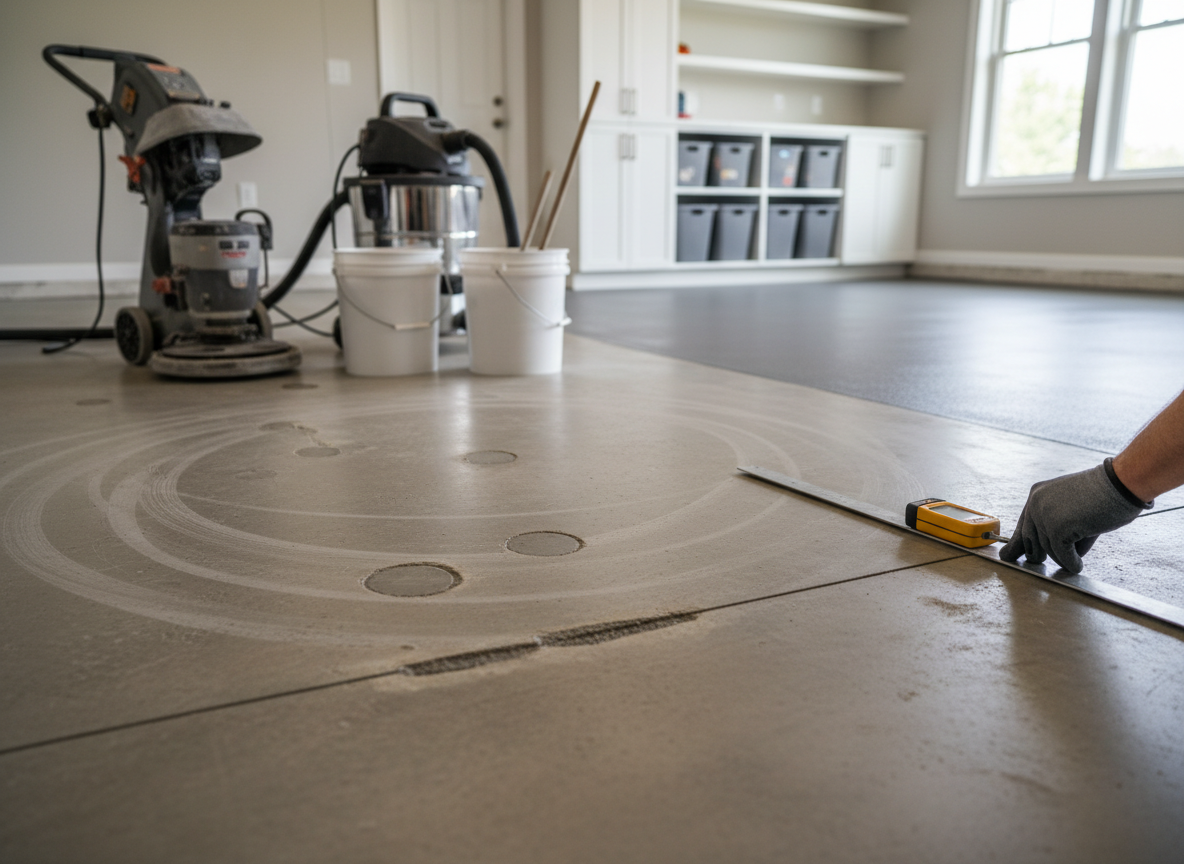
- How are you preparing the concrete — grinding or acid etching? Mechanical prep, usually diamond grinding, is the standard for a long-lasting floor because it opens the pores of the concrete so the base coat can bite in. Acid washing can sound easier, but it often doesn’t create the same consistent profile across the whole slab.
- What do you do with cracks, pitting, and old stains? Real garages have oil spots, tire marks, and small cracks. A solid plan includes cleaning, repairing, and leveling where needed, not just coating over problems.
- How do you handle the edges and stem walls? The perimeter is where shortcuts show up, so ask how they prep and coat the corners and the area near the garage door, where water and debris usually collect.
System Design
- Is this epoxy, polyaspartic, or a hybrid system, and why? You’re not looking for one “correct” answer — you’re looking for a thoughtful one that fits your garage.
- What’s the base coat doing, specifically? A good base coat should be chosen for how it bonds to concrete and how it builds thickness.
- Are you doing a full flake broadcast or a partial broadcast? This affects both the look and the feel underfoot, so ask what you’re actually getting.
Topcoat Details
- What topcoat are you using, and is it UV stable? If your garage gets sun, common across Virginia Beach, Norfolk, and Chesapeake, UV stability matters for keeping the floor looking clean over time.
- How many topcoats are included? This depends on the product, the texture, and how you use the garage, but the installer should be able to explain why.
- Will the floor be slippery when wet? Ask about traction additives and how they balance grip with easy cleaning.
Cure Time and Return to Service
- When can I walk on it, park on it, and put heavy items back? Fast cure sounds great until it’s rushed, so ask for realistic timelines for foot traffic, vehicle traffic, and heavy loads.
- What happens if the weather changes mid-install? A pro should have a plan for humidity, temperature, and dew point so the coating cures the way it’s supposed to.
Your Garage’s Use Case
- Is this garage mostly for parking, a workshop, or a home gym? A floor built for parking two cars may not be ideal for welding, woodworking, or heavy equipment.
- Do you store chemicals, fertilizers, or salt? Ask how the system handles spills and what cleanup is recommended.
Paperwork and Expectations
- What’s included in the written scope — prep, repairs, layers, and cleanup? The scope should spell out the prep method, crack repair approach, number of coats, broadcast level, and what “done” looks like.
- What warranty do you provide, and what does it actually cover? [WARRANTY LANGUAGE — PENDING]. Any warranty should be written, specific, and tied to proper prep and proper use.
Once you’ve worked through this checklist, the next step is putting the answers into context, especially for Virginia garages, where sun, humidity, and slab moisture can change what “best” really looks like.
Frequently Asked Questions
Polyaspartic vs. epoxy — what’s the main difference in plain English?
Epoxy is a thicker, slower-curing resin that bonds well to concrete and builds a solid base. Polyaspartic is a faster-curing coating often used as a topcoat because it holds up well in sunlight and resists wear. Many of the best garage floors use both in a hybrid system.
Polyaspartic vs. epoxy — which is better for a Virginia garage?
It depends on your garage and your goals. If UV exposure is a big concern, a UV-stable topcoat matters most. If your slab needs extra build or leveling, epoxy can help as a base. In many Virginia homes, a hybrid approach is the most practical balance.
Does epoxy always turn yellow?
Not always, but epoxy can amber or yellow with UV exposure, especially in garages that get direct sunlight. If yellowing is a concern, the system design and topcoat choice matter a lot. For a deeper explanation of why it happens and what to do about it, see our guide on epoxy floors turning yellow in Virginia Beach garages.
How fast can I use the garage after installation?
Cure time depends on the products used, the number of layers, and the temperature and humidity during install. A fast cure can mean quicker return to light foot traffic, but vehicle traffic and heavy loads may still need more time. A good installer will give you a clear schedule for walking, parking, and moving items back in.
Why do some garage floors peel or bubble?
The most common causes are moisture coming up through the slab, poor surface prep, or coating over contaminants like oil. That’s why moisture testing and mechanical prep are such big deal-breakers.
What does “hybrid system” mean for garage floors?
It usually means an epoxy base coat for strong adhesion and build, plus a polyaspartic topcoat for UV stability and wear resistance. It’s not a gimmick — it’s how many quality systems are designed to handle real-world conditions.
What affects polyaspartic floor coating cost the most?
The biggest cost drivers are surface prep, slab repairs, moisture conditions, total square footage, and the finish you choose, like a full flake broadcast. Polyaspartic materials can also cost more, especially when used as a high-performance topcoat. For professional installs in our market, pricing should never be quoted below $9/sq ft.
Should I DIY my garage floor coating?
DIY can work for some homeowners, but most long-term failures come from prep issues, especially moisture, profiling, and repairs. If you’re considering DIY, focus less on the label on the box and more on whether you can realistically prep the slab the way a pro crew can.
Ready When You Are
If you’re trying to decide between epoxy and polyaspartic, you’re asking the right question. The best choice isn’t a single product — it’s a system that matches your slab, your sun exposure, and how you actually use your garage. In Virginia Beach, Norfolk, Chesapeake, Williamsburg, Yorktown, and Newport News, we see humidity and moisture conditions that make prep and system design just as important as the coating name on the label.
If you’d like, we can take a look at your garage, talk through your goals, and recommend a system based on what your concrete is doing, not just what looks good in a photo. Request a quote anytime, and we’ll keep it straightforward and pressure-free.