
Why Garage Floor Pricing Feels So Confusing
If you’ve been pricing a garage floor coating lately, you’ve probably seen numbers that don’t add up. One company offers to “epoxy your garage” for a couple hundred dollars. Another quote comes back in the thousands. Then you go online and find a DIY kit that costs less than dinner out.
We get it. Garage floor epoxy pricing feels confusing on purpose. Here in Virginia Beach, it gets even trickier. We deal with coastal humidity, sandy garages (especially near Sandbridge, Oceanfront, or Shore Drive), and slabs that hold moisture longer than most people expect. That matters, because prep and moisture control decide whether a coating lasts or peels.
So let’s make this simple. This guide from our team at Showstopper Painting covers the real ranges we see for garage floor epoxy cost in Virginia Beach in 2026, and what actually drives those numbers. No fluff, just clear pricing and a neighbor-to-neighbor breakdown so you can make a smart call.
The Real Problem: Why Homeowners Get Burned
Most people don’t get burned on garage floor coatings because they picked the wrong color. They get burned because they thought they were buying one thing, and they actually bought something else. Here’s what usually goes wrong.
- Cheap quotes skip the hard part. A garage slab isn’t a clean, new countertop — it’s porous concrete that has soaked up moisture, oil, and tire residue for years. Coating rolled over dirty or smooth concrete may look fine for a few months, then start peeling or bubbling under hot tires.
- “Epoxy” gets used as a catch-all word. Some companies say “epoxy” when they really mean a thin epoxy paint or a bargain coating that isn’t built for garages. Others use “polyaspartic” like it’s automatically better, then charge premium prices without explaining what you’re getting.
- Moisture issues get ignored. In Hampton Roads, moisture vapor rising through the slab is common, especially in older neighborhoods or garages that stay closed up and humid. If a contractor doesn’t test for it, you’re gambling with your money.
That’s why pricing is all over the place. You’re not just comparing “epoxy.” You’re comparing prep, materials, and risk.
Quick Answer: What It Costs in Virginia Beach
Let’s get straight to it. These are the typical ranges we see for an epoxy garage floor in Virginia Beach in 2026.
A quick note on pricing: You’ll see a wide market range in 2026, roughly $4–$15+ per sq ft because “epoxy” can refer to very different coating systems, materials, and levels of surface preparation. Showstopper’s two-day full flake system typically runs $9–$12 per sq ft, and we don’t install one-coat basic systems. Your exact quote depends on your slab’s condition, the prep required, the project size, and the finish you choose.
Price Per Square Foot
- DIY kit (materials only): $150–$600, plus tools and repairs
- Basic pro epoxy (one coat plus clear): $4–$7 per sq ft, only if prep is solid. Showstopper’s two-day flake system typically runs $9–$12/sq ft; we don’t install one-coat basic systems.
- Full broadcast flake system (epoxy base + flake + polyaspartic topcoat): $6–$12 per sq ft
- Premium polyaspartic/polyurea systems: $9–$15+ per sq ft
Typical Total Cost by Garage Size
Garage sizes vary, but these are common: a 1-car garage runs about 200–300 square feet, a 2-car garage runs about 400–600 square feet, and a 3-car garage runs about 700–900 square feet. Here’s what that means for your total price.
| Garage Size | Sq Ft | Basic Epoxy ($4–$7/sq ft) | Full Flake ($6–$12/sq ft) | Premium ($9–$15+/sq ft) |
|---|---|---|---|---|
| 1-car | 200–300 | $800–$2,100 | $1,200–$3,600 | $1,800–$4,500+ |
| 2-car | 400–600 | $1,600–$4,200 | $2,400–$7,200 | $3,600–$9,000+ |
| 3-car | 700–900 | $2,800–$6,300 | $4,200–$10,800 | $6,300–$13,500+ |
What’s Usually Included in a Real Professional Job
This varies by company, but a legit scope usually includes the following.
- Moving lighter items, or giving you a clear prep list
- Concrete cleaning and degreasing
- Diamond grinding, or another mechanical prep method
- Crack and pit repairs, at least minor ones
- Base coat, plus broadcast if flake, plus topcoat
- Clean edges, clean cut lines, and a tidy jobsite
If a quote doesn’t clearly explain prep, repairs, and topcoat, it isn’t apples-to-apples with the others you’re comparing.
What You’re Actually Paying For (Cost Drivers That Matter)
When you ask how much it costs to epoxy a garage floor, you’re really asking what it takes to make the coating stick and stay looking good. Here’s what moves the price up or down.
Surface Prep Is the Foundation
- Diamond grinding (preferred): Industrial grinders with diamond tooling open up the concrete’s pores, roughing up the slab so the coating can bite in.
- Shot blasting (sometimes used): A more aggressive prep method that works well on certain slabs.
- Acid wash (a red flag for many garages): Acid etching can be inconsistent, especially on slabs with sealers, oil, or hard trowel finishes.
Prep affects price because grinding takes time, equipment, dust control, and skill. The more contaminated the slab — oil, tire marks, old paint — the more grinding and cleaning it needs.
Repairs: Cracks, Spalling, and Pitting
Concrete isn’t perfect. In neighborhoods like Kempsville, Norfolk, or parts of Chesapeake with older slabs, we often see hairline cracks from settling, spalling (flaking concrete), and pitting from salt, moisture, or old coatings. Repairs can include crack chasing, which opens the crack so repair material bonds properly, plus patch and skim work, plus joint work at control joints depending on the system. More repairs mean more labor, which means a higher price.
Moisture Testing and Mitigation
This is a big one in Virginia Beach. Moisture vapor is water vapor moving up through the concrete. You may not see puddles, but vapor pressure can still push against a coating from underneath. Moisture-related scope can include moisture testing so we know what we’re dealing with, a moisture-mitigating primer when needed, and extra cure time or scheduling adjustments. If a contractor never mentions moisture, that’s not confidence — that’s a shortcut.
Material Quality
Not all epoxies are the same. Three factors matter most. Solids percentage: higher solids usually means a thicker, more durable film. Topcoat type: polyaspartic topcoats cure fast and resist UV yellowing better than many epoxies. System design: a base coat alone isn’t the same as a full flake broadcast system with a protective topcoat.
Labor, Cure Time, and Scheduling
Labor cost isn’t just rolling paint. It includes prep work, masking and detail work, mixing and applying coatings within strict time windows, return trips for topcoats, and cure time before you can park. Fast-turnaround systems can cost more because they compress labor and scheduling.
Common Add-Ons That Change the Price
- Heavy grinding for old coatings, glue, or thick contamination
- Crack repair beyond minor patching
- Moisture mitigation primers
- Stem walls, the short walls around the slab
- Steps into the house
- Color upgrades or custom flake blends
- Metallic epoxy looks
- Rush scheduling or fast turnaround
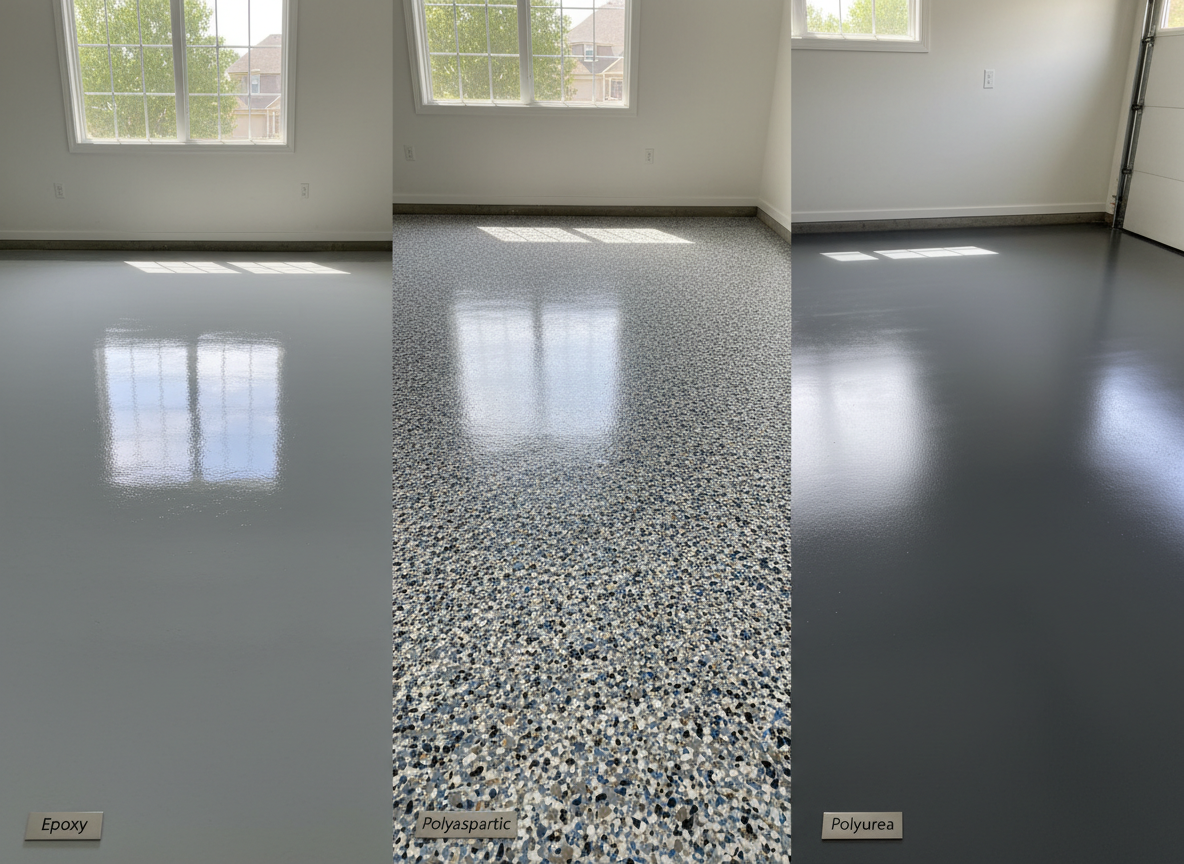
Epoxy vs Polyaspartic vs Polyurea: What’s the Difference?
People ask us this all the time, and it’s a great question. Here’s the simplest way to think about it. Epoxy is often used as the base coat because it bonds well and builds thickness. Polyaspartic is often used as a topcoat because it cures fast and handles UV better. Polyurea is often used in premium systems for fast cure and toughness, but it isn’t automatically better unless the prep and system design are right.
Comparison Table
| System | Cure Time | UV Stability | Durability | Best Use Cases | VA Beach Fit |
|---|---|---|---|---|---|
| Epoxy (basic + clear) | Slower (2–7 days) | Moderate to low | Good with solid prep | Budget garages, light use | Works if moisture is handled |
| Epoxy + full flake + polyaspartic | Faster (24–72 hrs) | Better | Very good | Most homeowners | Excellent for sand + wear |
| Polyaspartic/Polyurea premium | Fast (same-day) | High | Excellent | High-use, workshops | Great when moisture is tested |
Quick Advice on Choosing
- If your garage door stays open a lot, sunlight exposure means UV stability matters more.
- If you track in sand and salt (Oceanfront, Shore Drive, Sandbridge), abrasion resistance and easy cleaning matter more.
- If you want the best balance of looks and durability, full flake with a quality topcoat is the sweet spot for many homes.
DIY Epoxy Kits vs. a Professional Install
DIY kits from big-box stores can be a reasonable way to improve a low-use garage, but it helps to understand what you’re actually buying. Many kits are thin coatings, not true multi-layer epoxy systems designed for long-term garage wear.
When DIY floors fail, the issue is usually surface prep, not the product itself. Concrete needs the right profile and cleanliness for any coating to bond.
A professional install typically includes grinding/profiling the slab, moisture testing, and crack repair before any coating goes down. That prep work is a big part of what you’re paying for—and a big part of what makes the floor last.
Why We Don’t Do One-Day Epoxy Floors
You’ll see companies advertise “one-day garage floors,” and to be fair, fast-curing products do exist. Some systems are designed to go down quickly and get you back in service fast.
The tradeoff is that speed can put pressure on the parts of the job that matter most: cure time, adhesion, and long-term lifespan. In real garages—especially in Virginia Beach where humidity and moisture vapor are common—those details aren’t optional.
At Showstopper Painting, we run a deliberate two-day process because that’s what a floor that lasts requires. Day one is about getting the slab right: mechanical prep, repairs, and setting the foundation so the coating can bond the way it’s supposed to. Day two is about building and protecting the system with the right layers and cure windows, so you don’t end up with a floor that looks good for a season and then starts peeling under hot tires.
If you’re comparing quotes, this is one of the biggest “apples-to-apples” differences to look for: whether the contractor is building in the time needed for prep, proper application windows, and a finish that’s meant to hold up in daily life.
DIY vs Hiring a Pro
DIY can be tempting, and we’re not here to shame anyone for trying it. But we want you to see the full picture, because the kit price isn’t the whole cost.
True DIY Costs
Materials and tools add up fast.
- DIY kit: $150–$600
- Concrete cleaner/degreaser: $20–$60
- Crack repair materials: $30–$150
- Diamond cup grinder or floor grinder rental: $75–$250 per day
- Vacuum and dust control supplies: $30–$150
- Rollers, squeegees, mixing buckets, and spike shoes: $40–$150
Add in time, realistically 1 to 2 full weekends for prep, coating, and cure management.
DIY vs Pro at a Glance
| Factor | DIY | Hiring a Pro |
|---|---|---|
| Upfront cost | Lower: $150–$600+ in materials and rentals | Higher: $4–$15+ per sq ft on average. Showstopper’s two-day flake system typically runs $9-$12/sq ft, we don’t install one-coat basic systems. |
| Time investment | 1–2 full weekends of your time | Scheduled around your calendar |
| Surface prep | Depends on your equipment and technique | Diamond grinding or shot blasting done right |
| Moisture handling | Often skipped or guessed at | Testing and mitigation built into the process |
| Common failure points | Bubbles, peeling, hot tire pickup, weak bonding | Backed by experience and warranty terms |
| Best for | Low-use storage garages, hands-on homeowners | Daily-use garages, moisture-prone areas |
When DIY Makes Sense
- You’re okay with a shorter lifespan
- The garage is low-use, storage only
- You’re willing to grind properly and accept the learning curve
When Hiring a Pro Makes Sense
- You want it to last and look consistent
- You have oil stains, old paint, or unknown slab issues
- You park daily and want hot-tire durability
- You’re in a moisture-prone area, which is common in Hampton Roads
If you’re already thinking, “I really don’t want to do this twice,” that’s usually the sign to bring in a pro.
Virginia Beach-Specific Factors That Affect Price
Garage floor coatings aren’t one-size-fits-all, and Virginia Beach has a few local quirks that can change the scope.
Humidity and Moisture Vapor
Coastal humidity is real. In summer, garages can feel like a greenhouse. Concrete can hold moisture longer, coatings have application windows for temperature and humidity, and cure times can shift. That can mean more moisture testing, moisture-mitigating primers when needed, and more careful scheduling to hit ideal conditions.
Garages Near the Ocean: Salt and Sand
If you’re closer to the water— Oceanfront, Croatan, Sandbridge, Shore Drive, you’ll often see more sand tracked in, more salt residue, and faster wear on low-quality coatings. A tougher topcoat and a full broadcast system can be worth it in these areas.
Older Slabs and Settling Cracks
In established neighborhoods, including Kempsville and parts of Norfolk and Suffolk, slabs can have old patchwork repairs, control joints that move, and cracks that need proper repair materials. Repairs aren’t always expensive, but they do add time.
Seasonal Scheduling
Spring and summer are busy for home improvement in Hampton Roads. If you want a specific week, especially around holidays, you may see longer lead times and limited rush slots. We always recommend planning ahead if you want a fast turnaround.
Our Approach at Showstopper Painting
We’ve been in this business for years, and here’s what we’ve learned: most coating problems aren’t bad luck, they’re predictable. That’s why our approach is simple: prep first, clear scope, and no mystery products.
What You Can Expect From Our Team
- Clear, written scope so you know what’s included
- A prep-first mindset, because coatings only perform as well as the slab prep
- Respectful crews and a clean jobsite
- Straight answers about what your slab needs, and what it doesn’t
How We Think About Trust and Risk
Choosing a contractor is a trust decision. You’re letting someone work on your home, and you want to know you’re not getting sold a story. We also believe homeowners should have a safety net. That’s why we publish our 100% Money Back Guarantee details, so you can understand how it works and what it covers.
You can read it here: 100% Money Back Guarantee
And just to be clear: exact pricing still depends on square footage, prep needs, and moisture conditions. We’ll always confirm those before giving a final number.
How to Compare Quotes (Avoid Upsells and Scams)
This is the part we wish every homeowner had before they started collecting quotes. A good quote should feel specific. You should be able to point to the line items and say, “Okay, I understand what I’m paying for.”
Quote Comparison Checklist
- How are you prepping the slab? Diamond grinding, shot blasting, or something else?
- Are you doing moisture testing? If yes, what happens if moisture is high?
- What exact product system are you using? Brand or system name if possible.
- How many coats? Base coat, broadcast, and topcoat?
- What topcoat is included? Epoxy, polyaspartic, or polyurea?
- What’s the estimated mil thickness? A mil is a thousandth of an inch — thicker isn’t always better, but “unknown” is a red flag.
- What repairs are included? Cracks, pits, spalling?
- What are the warranty terms? Get it in writing.
Red Flags to Watch For
- A quote that’s way cheaper than everyone else with no explanation
- Vague language like “epoxy paint” with no system details
- No mention of grinding or mechanical prep
- No discussion of moisture in a coastal area
- Pressure tactics, like “today only pricing” or “we can’t write it down”
A Real-World Example: A Two-Car Garage in Kempsville
Let’s say you have a standard two-car garage, about 450–500 square feet, in Kempsville. There are a few oil stains where the mower sits, the slab has a couple hairline cracks, and the garage door stays closed most of the time, so it’s humid. In that situation, a contractor who plans for grinding, stain treatment, crack repair, and a full flake system will price higher than someone who just etches and rolls. But the first option is also the one that’s far more likely to still look good a few years from now.
Project Timeline: What to Expect
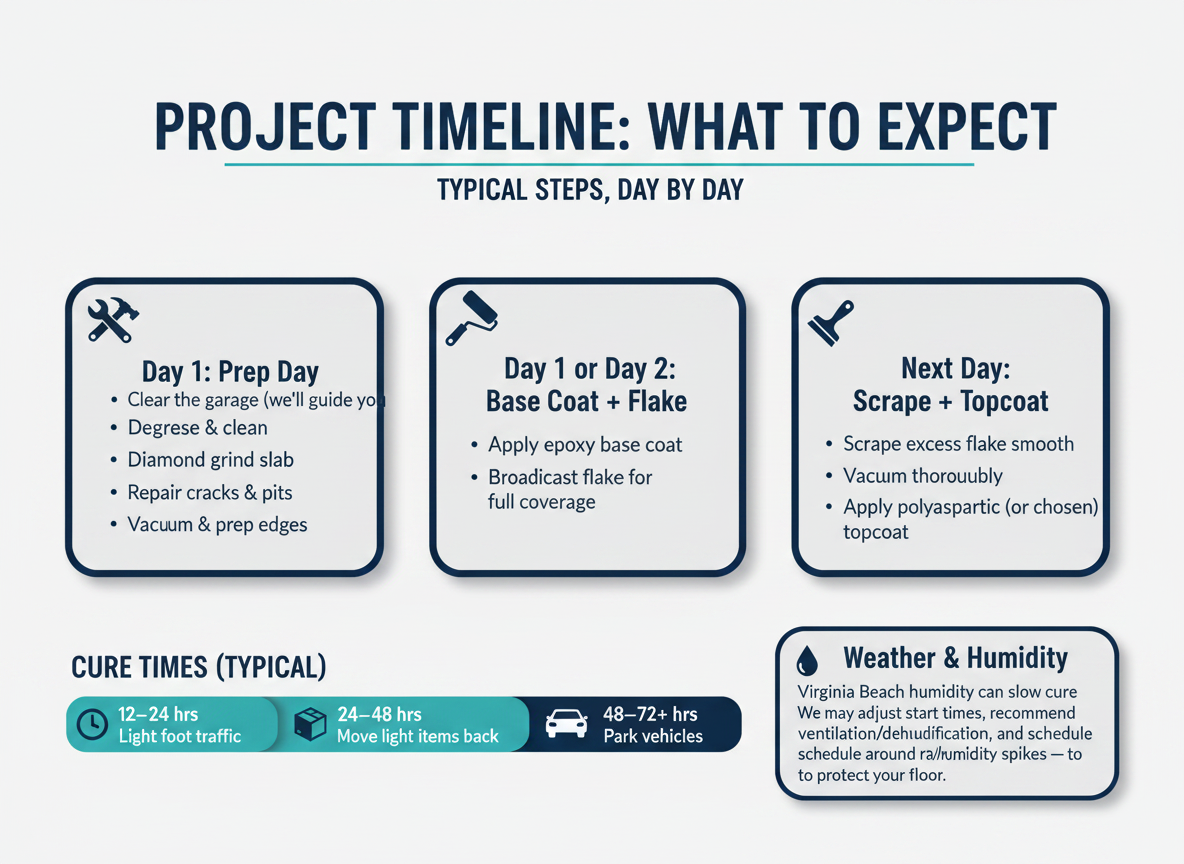
Most homeowners want to know two things: how long will the crew be there, and when can they park in the garage again? The honest answer depends on the system and the weather, but here’s a typical timeline for a professional flake system.
Typical Steps, Day by Day
- Day 1, prep day: Clear the garage (we’ll guide you on what to move), degrease and clean, diamond grind the slab, repair cracks and pits, vacuum and prep edges
- Day 1 or Day 2, base coat and flake broadcast: Apply the epoxy base coat and broadcast flake for full coverage
- Next day, scrape, vacuum, and topcoat: Scrape excess flake smooth, vacuum thoroughly, and apply the polyaspartic or chosen topcoat
Cure Times
Always follow the system’s requirements, but typical ranges look like this: light foot traffic is often okay after 12–24 hours, moving light items back in is often fine after 24–48 hours, and parking vehicles usually needs 48–72+ hours.
How Weather and Humidity Affect the Schedule
In Virginia Beach, humidity can slow cure times or change the best application windows. During stretches of sticky weather, we may adjust start times, add ventilation or dehumidification recommendations, and schedule around rain and humidity spikes. That’s not us being picky — that’s us protecting your floor.
Helpful Links
If you’re planning multiple upgrades, these pages may help.
Learn about our epoxy floor installation services.
If you’re also refreshing the home, see our residential painting options.
Thinking about curb appeal and exterior painting?
Frequently Asked Questions
How long does epoxy last in a garage?
With solid prep and the right system, a professional garage coating can last for years. Lifespan depends on prep quality, moisture, daily use, and whether you have a protective topcoat.
Can you epoxy over cracks?
Yes, in many cases. Cracks usually need to be cleaned, opened, and filled with the right repair material first. Some cracks can reappear over time if the slab keeps moving.
Is polyaspartic worth the extra cost?
Often, yes — especially if you want a faster return to service and better UV stability. Many homeowners choose an epoxy base with a polyaspartic topcoat for a strong balance of cost and performance.
How soon can I park on my coated garage floor?
Typical ranges are 48–72+ hours, depending on the system and humidity. We’ll give you a clear cure-time plan for your specific project.
Will it peel if my slab has moisture?
It can. Moisture vapor is one of the biggest reasons coatings fail. That’s why moisture testing and the right primer, when needed, matter so much in Virginia Beach.
What’s the best coating for coastal Virginia (sand and salt air)?
A: A full broadcast flake system with a durable topcoat is a popular choice because it hides dirt well and holds up to abrasion. The best system still depends on your slab condition and moisture.
Why are some quotes so cheap?
Usually because prep is reduced, such as skipping grinding, or the materials are thinner and lower grade. Cheap coatings can look good at first and fail later.
Is acid etching enough prep for epoxy?
Sometimes it can work, but it’s often inconsistent on garage slabs, especially if there are sealers, oil stains, or hard finishes. Mechanical prep like diamond grinding is more reliable.
What does “diamond grinding” mean?
It’s using a heavy-duty floor grinder with diamond tooling to roughen and open the concrete surface so the coating can bond properly.
What is a “flake broadcast” system?
After the base coat goes down, decorative vinyl flakes are spread across the wet coating. In a full broadcast, the flakes cover the whole floor, then a clear topcoat seals everything in.
What is a topcoat, and why does it matter?
The topcoat is the protective clear layer. It helps with scratch resistance, chemical resistance, and UV stability, depending on the product.
Can you coat a garage floor that had old paint on it?
Often yes, but it usually requires heavier grinding to remove or properly profile the old coating. That extra prep can increase cost.
Final Thoughts
If you remember nothing else, remember this: garage floor coating prices in Virginia Beach swing because prep and moisture swing.
Typical ranges we see are $4–$7 per sq ft for basic pro epoxy when prep is straightforward, $6–$12 per sq ft for a full flake system with a polyaspartic topcoat, and $9–$15+ per sq ft for premium polyaspartic or polyurea systems. Showstopper’s two-day flake system typically runs $9–$12/sq ft; we don’t install one-coat basic systems.
If you’re in Virginia Beach, Norfolk, Chesapeake, or Suffolk and you want a clear, no-pressure estimate, our team is happy to take a look at your slab, talk through options, and give you a scope you can actually compare. Even if you don’t hire us, you’ll walk away understanding what you’re being quoted — and why.