
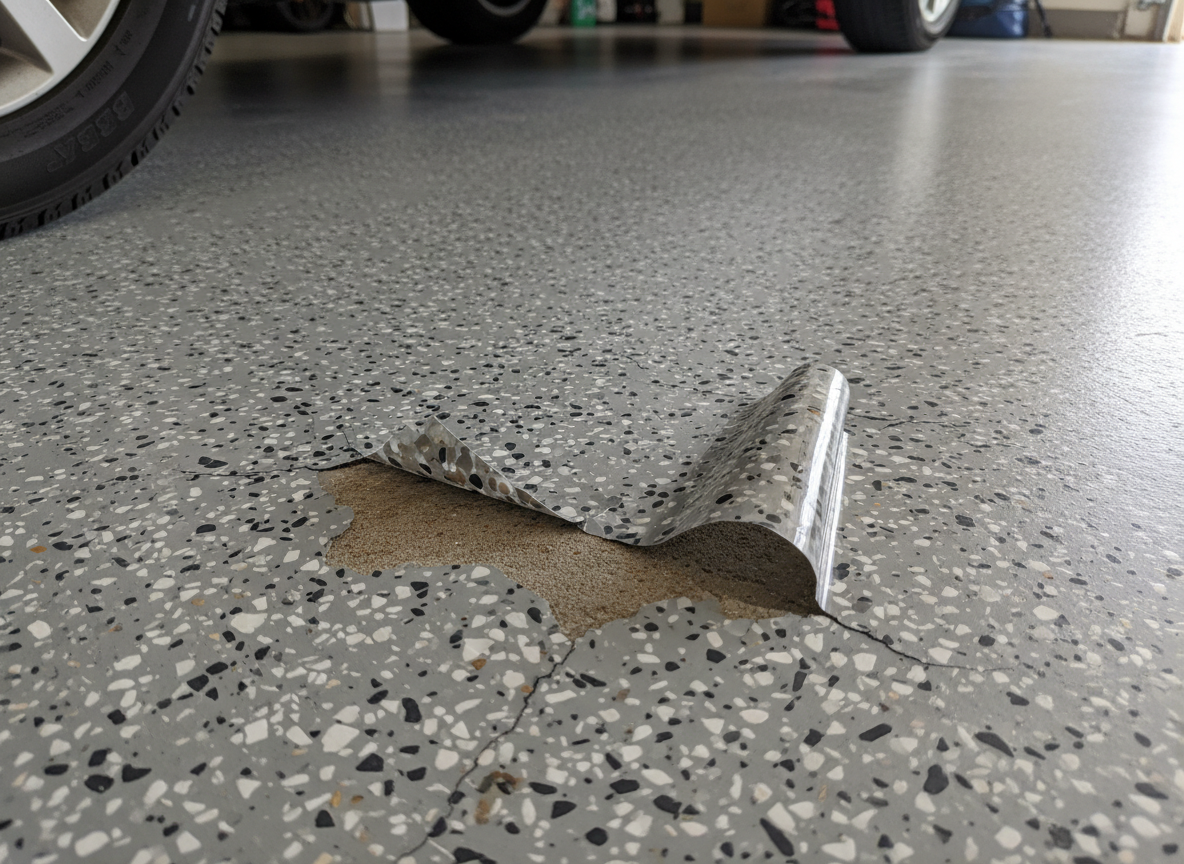
If you’ve walked into your garage and thought, “Why is my floor peeling right where I park?”, you’re not imagining things. The rest of the coating might still look fine. But under the tires, you see strips, patches, or flakes lifting up, almost like tape being pulled off the concrete.
We see this a lot in Virginia garages, from Virginia Beach to Norfolk, Chesapeake, and Suffolk. It usually shows up after normal life happens: summer heat, humid air, and a car that just came off hot asphalt. The good news is that this problem has a name. Once you understand what causes it, you can stop guessing and start making a real plan.
This article covers peeling and lifting under tires, known as hot tire pickup. If your floor is changing color instead — especially near the garage door where sunlight hits — that’s usually a different issue. Read about epoxy floors turning yellow here.
What “Hot Tire Pickup” Means
Hot tire pickup happens when your tires get warm from driving, then sit in one spot on the garage floor. That heat can soften the coating, and the weight of the car presses the tire into it. When you back out later, the tire can grab the coating and pull it right up from the concrete.
The damage usually looks pretty specific:
- Peeling or missing coating in two clean, tire-shaped areas
- Strips that look like the coating was peeled off like a sticker
- Rough, lifted edges where the coating is separating from the slab (this is called delaminating)
Quick definition: Delaminating means the coating is separating from the concrete underneath. It’s losing its grip.
A lot of homeowners tell us the same thing: “It looked great at first.” That’s normal. Hot tire pickup often shows up after the floor has been in service for a while, especially during warm months when garages in Williamsburg, Yorktown, and Newport News can feel like ovens by late afternoon. Add coastal humidity in places like Virginia Beach, and you’ve got the perfect setup for a coating to fail if the system or the prep work wasn’t right.
Why It Happens: The Root Causes
Hot tire pickup isn’t random. In our experience, it almost always comes back to one of a few root causes. Here’s the simple version: the coating either wasn’t built strong enough, wasn’t bonded to the concrete well enough, or wasn’t ready for car traffic yet.
Thin, Single-Part Coatings
Some coatings are “single-part,” meaning they aren’t mixed with a hardener. They can look nice going on, but they’re often thinner and softer than a true two-part system. When hot tires sit on them, they can soften and let go.
Inadequate Surface Prep
This one is huge. Concrete needs texture for a coating to grab onto, we call that texture a surface profile. If the slab is too smooth, or if it still has old sealer, paint, or residue on it, the coating is basically trying to stick to a surface that isn’t ready to hold it.
Quick definition: Mechanical prep means using professional grinding equipment to open up the concrete’s surface. It’s not just cleaning— it’s creating the right bite so the coating can bond.
Vehicle Traffic Too Soon
This is where a lot of people get tripped up. A floor can feel dry to the touch and still not be cured.
Quick definition: Dry means it doesn’t feel wet. Cured means it has hardened all the way through, chemically, and can handle real use like vehicle weight and tire heat.
If a car goes back in too soon, the tires can imprint the coating, soften it, or pull it loose before it has fully locked onto the slab.
Dry vs. Cured
| Term | What It Means | What It Can Handle |
|---|---|---|
| Dry | Surface feels dry to the touch | Light foot traffic, sometimes |
| Cured | Coating has fully hardened through a chemical reaction | Vehicle traffic, tire heat, real daily use |
In Virginia, timing matters even more than most people expect. Humidity and temperature swings — especially in garages that aren’t climate-controlled — can slow down curing or create conditions where a coating struggles to bond. That doesn’t mean epoxy can’t work here. It just means the prep, the product, and the cure schedule all have to match real Virginia garage life.
What It Looks Like vs. What It Actually Is
Here’s one more important point: hot tire pickup usually isn’t a surface scratch. It’s typically a bond failure, meaning the coating is letting go of the concrete (or letting go between layers). That’s why it peels off in sheets instead of wearing down slowly over time.
If you’re seeing any of these, you’re likely describing the classic hot tire pickup pattern:
- Garage floor coating peeling
- Epoxy lifting where you park
- Epoxy peeling under tires
- Garage floor coating delaminating
And here’s the key takeaway before we get into DIY kits: once a coating starts letting go, it usually doesn’t stop on its own. The edges keep lifting, dirt and moisture work their way underneath, and the problem spreads.
Why DIY Kits Often Fail
We get why DIY kits are tempting. You see a weekend project and a nice photo on the box, and you think, “How hard can this be?” Honestly, a lot of these floors do look great at first. The problem is that hot tire pickup doesn’t show up on day one. It shows up after real life happens: hot tires, parking in the same spot, humidity, and a few months of normal use.
In Virginia Beach, Norfolk, and Chesapeake, we see the same pattern again and again. The coating fails where the tires sit because the system is usually too thin, the concrete wasn’t prepped deeply enough, or the floor went back into service before it was truly cured.
The Biggest Reasons DIY Kits Struggle
Most people think prep just means cleaning the floor really well. Cleaning matters, but it isn’t the same as creating a bond-ready surface. Concrete needs texture, or a surface profile, so the coating can lock in. If the slab is smooth, sealed, or contaminated with oil, tire residue, or old paint, the coating may stick at first and then release later under heat and pressure.
Film build, or the thickness of the coating once it’s applied and cured, is another common issue. Thin coatings soften faster under tire heat and don’t have much strength to resist peeling. Many DIY systems go on thin, especially if the slab soaks up material unevenly.
Cure-time misunderstandings are one of the most common issues we see. A floor can feel dry and still be chemically soft underneath. If you park too soon, the tires can grab and lift the coating before it has fully hardened. This is exactly why a coating can look good at first and then fail once real tire heat and weight test it. Walking across a floor in socks is nothing like a warm, heavy tire sitting in one spot.
If you’re thinking, “Okay, so what should have been done differently?”, that’s exactly the right question to ask next.
What Prevents Hot Tire Pickup: A Prevention Checklist
When we install garage floor coatings across Suffolk, Williamsburg, Yorktown, and Newport News, we focus on three things: prep, product, and patience with cure time. Here’s the checklist that prevents hot tire pickup in the real world.
1. Proper Mechanical Profile on the Slab
Concrete needs to be mechanically prepped, meaning we use professional grinding equipment to open up the surface and create the right texture. This matters because it:
- Removes weak top layers and contamination
- Creates a “tooth” for the coating to grip
- Helps the coating bond evenly instead of just sitting on top like paint
If the coating can’t bond deeply, hot tires are much more likely to pull it loose.
2. A Real Two-Part System With Adequate Film Build
A two-part system means the coating is mixed with a hardener so it cures into a tougher, more chemical-resistant surface. It’s not just drying — it’s hardening through a chemical reaction. Just as important, it needs enough thickness (film build) to handle heat and weight without softening and releasing.
3. Full Cure Before Vehicle Traffic
We’re strict about cure time because we’ve seen what happens when people rush it. In Virginia’s humidity, especially in coastal air around Virginia Beach and Norfolk, cure schedules matter. A simple rule of thumb: if it’s only been a short time and the floor “seems fine,” that doesn’t mean it’s ready for tires. Parking too soon is one of the fastest ways to trigger hot tire pickup.
How We Prevent It: Showstopper’s Approach
When our team installs a garage floor coating, we’re not aiming for “looks good for a few weeks.” We’re aiming for a floor that holds up when you park in the same spot every day, in real Virginia conditions. Here’s what that looks like in practice:
- We mechanically prep the slab to create the right surface profile. This is the foundation — without it, nothing else matters.
- We use a true two-part system designed for garage conditions, built to cure hard and resist heat, weight, and daily use.
- We build the coating to the right thickness. Thin coatings are more likely to soften under hot tires, so adequate build helps resist pickup and peeling.
- We follow cure-time rules before vehicle traffic. We don’t treat “dry” as the finish line — we treat “cured” as the finish line.
If you want a clear overview of what a professional install should include, this page lays it out. It’s also a helpful way to figure out whether your current floor was installed with the right prep and process.
1-Part vs. 2-Part Coating
| Feature | 1-Part Coating | 2-Part System |
|---|---|---|
| Mixed with hardener | No | Yes |
| How it hardens | Mostly “dries” | Chemically cures (hardens) |
| Typical thickness | Often thinner | Can be built thicker |
| Hot tire pickup resistance | More likely to fail | More resistant when installed right |
| Common DIY outcome | Looks good early, peels later | Better long-term performance |
What To Do If It’s Already Peeling
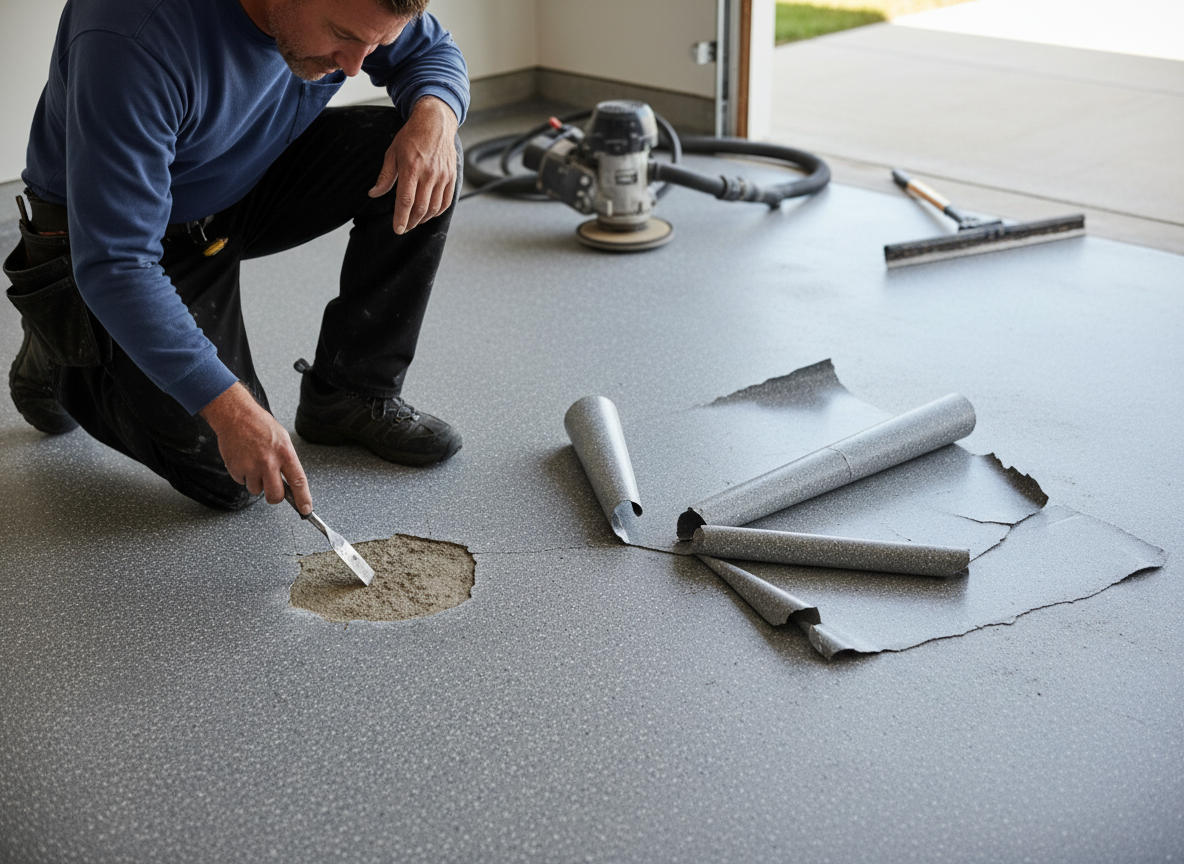
If your garage floor coating is peeling exactly where you park, you’re not alone. We’ve walked into garages in Virginia Beach, Norfolk, Chesapeake, and Suffolk and seen the same thing: two tire-shaped areas where the coating got picked up and pulled away. When this starts, the goal is simple — don’t let a small failure turn into a bigger one, and don’t spend money on a fix that can’t bond.
Step 1: Don’t Peel It Further
It’s tempting to grab the loose edge and keep pulling, because it feels satisfying and you just want it gone. But peeling it up usually makes the failure bigger. You can pull up a coating that’s still partially bonded, widen the lifting edge, and make it harder to figure out what’s going on underneath. If you need to make the area safer so you’re not catching shoes on it, you can lightly trim a loose flap that’s already detached. Just avoid turning it into a full removal project without a plan.
Step 2: Take Photos and Note the Pattern
Before anything changes, take a few clear photos: a wide shot of the whole garage, close-ups of the peeling edges, and a shot showing that the damage lines up exactly with where the tires sit. Also jot down when it started, how long after installation you parked on it, and whether any cleaners or degreasers were used before the coating went down. That information helps a lot when figuring out whether this is a prep issue, a product issue, a cure-time issue, or some combination.
Step 3: Get It Assessed
If a coating is lifting, the real question is why it lost its bond. A proper assessment looks at adhesion (how well the coating is actually bonded), moisture coming up through the slab, the surface profile or mechanical prep, and the coating’s thickness.
Moisture is a bigger factor than most people expect, especially in coastal areas like Virginia Beach and Norfolk, where humidity and slab moisture can weaken bond over time. It also helps to understand whether the coating failed at the concrete or between layers, since the fix depends on which one you have.
Quick definition: Bond failure can happen at the slab, where the coating releases from the concrete, or between layers, where the top layer releases from the base layer.
Step 4: Know That Recoating Over a Failing Coating Usually Doesn’t Hold
This is the part people don’t want to hear, but it saves you time and money: recoating over a failing coating usually doesn’t hold. The new coating can only bond as well as the layer underneath it. If the old coating is already delaminating, it isn’t a stable foundation, and you can end up with a thicker failure that peels in bigger sheets later. In plain terms, if the original coating is letting go, adding more coating on top is a lot like painting over peeling paint. It might look better for a little while, but the weak layer underneath is still weak.
Step 5: Avoid Quick Fixes That Make the Redo Harder
A few common shortcuts can make a professional redo more difficult later:
- Smearing patch material into peeling areas without removing the loose coating first
- Rolling on a “refresh coat” over a floor that’s already lifting
- Using harsh chemicals that soak into the slab and create bonding issues
If you’re not sure what’s safe to try, pause and get guidance before experimenting.
Can You Recoat It, or Do You Need a Full Redo?
This is the big decision point, and here’s the simple way we explain it.
A recoat might be possible if the existing coating is firmly bonded everywhere with no widespread lifting, the problem is limited and clearly identified, and the surface can be properly prepped — mechanically, not just scuffed — for a new layer. Even then, it’s not a roll-and-go job. The surface still has to be prepared correctly so the new layer can bond.
A full redo is usually the right call when the coating is peeling under tires and the edges keep lifting, when you can lift more coating with light pressure, when the failure is showing up in multiple areas or spreading, or when the coating is releasing cleanly from the slab, which is a sign the slab wasn’t prepped right in the first place. If the floor is failing, the correct fix is typically to remove the failing coating, mechanically prep the slab, and install a proper system from the ground up. That’s not bad news so much as it’s the honest path that actually holds.
Our Stance on Re-Coats and Tear-Outs
Yes, we do take on re-coat and tear-out jobs for floors that were previously coated and failed. We’ve done this for homeowners across Chesapeake, Suffolk, Newport News, and Yorktown. But we want to set expectations clearly: we don’t treat it like a discount fix. If the coating is failing, the correct approach is usually a full redo, and it’s typically priced like a full job because the labor and prep are real.
In many cases, tear-out work is more involved than a first-time install. The old coating has to be removed fully, not just sanded. The slab has to be brought back to a clean, bond-ready surface. And any contamination or moisture issues have to be addressed before the new system goes down.
If you want to see what a proper install process should include, and what your current floor may have missed, this is a helpful reference.
What To Do If It’s Already Peeling
If your garage floor coating is peeling exactly where you park, you’re not alone. We’ve walked into garages in Virginia Beach, Norfolk, Chesapeake, and Suffolk and seen the same thing: two tire-shaped areas where the coating got picked up and pulled away. When this starts, the goal is simple — don’t let a small failure turn into a bigger one, and don’t spend money on a fix that can’t bond.
FAQ: Hot Tire Pickup on Epoxy Garage Floors
What is hot tire pickup on an epoxy garage floor?
Hot tire pickup is when warm vehicle tires soften a floor coating and pull it up from the concrete when the car sits and then backs out. It often leaves peeling strips or patches exactly where the tires rest. It’s a common reason homeowners search “hot tire pickup epoxy” or “epoxy lifting where I park.”
Why is my garage floor coating peeling only where I park?
That pattern is a classic sign of hot tire pickup. The tire area gets the most heat and pressure, so any weakness in the coating system shows up there first. The root cause is usually thin coating, poor concrete prep, or parking on the floor before it fully cured.
Is hot tire pickup caused by the tires being too hot?
Heat from the tires is part of it, but it’s usually not the real problem. A properly installed two-part coating with good prep and full cure time should resist normal tire heat. When hot tire pickup happens, it usually points to a coating system or installation issue, not something you did wrong by driving your car.
What does “delamination” mean on a garage floor coating?
Delamination means the coating is separating from the surface underneath. On a garage floor, that usually means the coating is losing bond to the concrete slab, or sometimes to the layer below it. Delamination is why the coating peels in sheets instead of wearing down slowly.
Can I just recoat the peeling spots?
In most cases, recoating over a failing coating does not hold. The new layer can only bond as well as the layer underneath. If the existing coating is already lifting or peeling, it isn’t a stable base, so the problem often comes back, sometimes worse.
Why do DIY kits fail with hot tire pickup so often?
DIY kits fail most often because of prep and thickness. Homeowners usually don’t realize how important mechanical prep is, and many DIY coatings go on thin. Cure time is another common issue, since floors can feel dry but not be fully cured for vehicle traffic.
What’s the difference between “dry” and “cured”?
Dry means the surface isn’t wet to the touch. Cured means the coating has fully hardened through a chemical process and can handle real use like vehicle weight and tire heat. A floor can be dry and still not be cured, especially in humid Virginia conditions.
Does Virginia humidity make hot tire pickup more likely?
It can. In places like Virginia Beach and Norfolk, coastal humidity and seasonal temperature swings can affect how coatings cure and how moisture behaves in the slab. That’s why prep, product selection, and cure schedule matter so much for long-term performance.
If my floor is peeling, should I peel the rest up myself?
We don’t recommend it. Pulling on loose edges can make the failure bigger and can remove areas that are still partially bonded. It’s better to document the damage, avoid spreading it, and have the floor assessed so you know what you’re dealing with.
Will parking mats or cardboard stop hot tire pickup?
They might reduce direct contact, but they don’t fix the underlying bond issue. If the coating is already delaminating, the right long-term solution is addressing the failed coating and the prep underneath. Mats can be a temporary damage-control step while you plan a proper fix.
Do you take on re-coat or tear-out jobs for previously failed floors?
Yes. Our team does take on re-coat and tear-out jobs where a previous coating failed. We’ll assess adhesion, moisture, and prep so we can recommend the correct fix. If it’s failing, the correct approach is often a full redo, and it’s typically priced like a full job, not a small patch.
Is this the same issue as epoxy turning yellow?
Not usually. This article is about peeling and hot tire pickup, which is a bond and adhesion problem. Yellowing is usually a UV or color-stability issue, especially near sunlight exposure by the garage door. If your main issue is color change, here’s a related read.
Conclusion: What To Do Next
If your garage floor coating is peeling exactly where you park, it’s almost always hot tire pickup, and it’s usually a sign the coating wasn’t built or bonded for real vehicle use. The most common causes are thin single-part coatings, not enough mechanical prep, or putting the car back in before the coating fully cured. Once a coating starts delaminating, it rarely stabilizes on its own.
The smart next step is to stop the peeling from spreading, get the floor assessed, and make a plan based on what’s actually happening with adhesion, moisture, prep, and coating thickness. If you’re trying to understand what a correct install should look like, this is a helpful reference.
If you’re in Virginia Beach, Norfolk, Chesapeake, Suffolk, Williamsburg, Yorktown, or Newport News and want a clear answer on whether your floor can be re-coated or needs a full redo, reach out for a quote. We’ll look at the failure pattern, talk through your options, and recommend the fix that actually holds — no guesswork, no band-aids. If warranty comes up during that conversation, we’ll share the current terms: [WARRANTY LANGUAGE — PENDING].