
You want your home to look sharp. Maybe you’re getting ready for summer guests, thinking about selling, or you’re just tired of faded siding and peeling trim. Either way, you probably want the same thing most Virginia homeowners want: a fresh exterior, done quickly, without the project dragging on for weeks.
Here’s the part most homeowners don’t expect. In Virginia, the timeline isn’t only about how fast painters can paint. It’s also about prep work, dry time, and the weather doing what it does best—humidity, pop-up rain, salty air near the coast, and those spring and fall temperature swings that can change the plan overnight.
At Showstopper Painting, we handle exterior projects across Virginia Beach, Norfolk, Chesapeake, Suffolk, and surrounding areas all the time. So in this guide, we’ll give you a clear, realistic answer to the question: how long does an exterior paint job take in Virginia? We’ll also show you what happens each day, what can slow things down, and how to plan your week so the process feels smooth.
If you’re still deciding whether now is the right time to paint, you can also skim our full exterior house painting page for an overview of options and what we include.
The Short Answer: Most Exterior Paint Jobs Take 3–7 Working Days
For most homes, a professional exterior paint job takes about 3 to 7 working days from start to finish.
That range is real, and it’s there for a reason. A smaller one-story home with easy access and light prep might land closer to 3–4 days. A typical two-story home with normal prep and detailed trim is often 5–7 days. And if we’re dealing with heavier scraping, wood repairs, multiple colors, or weather delays (which can happen fast in coastal Virginia), it can stretch to 7–10+ days.
So if you’ve been searching for an exterior house painting timeline and every answer feels vague, you’re not imagining it. The timeline depends on a few big factors, and we’ll break them down clearly in this article.
Exterior House Painting Timeline: What Happens Each Day
A quality exterior paint job is a process. It’s not just “paint the walls.” It’s cleaning, prep, repairs, protection, priming, painting, and finishing details. That’s how you get a result that holds up through Virginia humidity, summer storms, and salty air near the coast.
Below is the step-by-step flow most professional projects follow. Your exact schedule may shift based on your home and the weather, but this will give you a solid exterior painting time estimate you can actually plan around.
Day 1: Setup and Washing
Most projects start with protecting your property before we start cleaning.
We’ll cover or move what needs to be protected, like outdoor furniture, grills, planters, and delicate landscaping. Then we clean the exterior to remove dirt, mildew, pollen, and chalky residue from old paint. In Virginia Beach and other coastal areas, this step is especially important because salty air and moisture can leave buildup that paint won’t stick to.
One thing to know right away: washing is quick, but drying takes time. In humid Virginia weather, siding can stay damp longer than homeowners expect. And we don’t want to trap moisture under new paint. That’s a recipe for early failure.
If you’re also planning to refresh outdoor wood surfaces, the same “clean and dry” rule applies. Our deck and fence painting page explains that timeline too.
Day 2: Scraping, Sanding, and Surface Prep
This is the day that makes the paint job last.
If paint is peeling, we scrape it. If edges are rough, we sand them so the surface feels smooth and looks even after painting. If the old coating is chalky (that powdery residue you can rub off on your hand), we address it so the new paint can bond properly.
This is also when we often find the issues that change timelines the most. Things like failed caulk lines, small cracks, soft trim boards, or hidden wood rot around windows and doors. In Norfolk exterior painting and Chesapeake exterior painting projects, it’s common for one side of the home to be more weathered than the other, which means prep can vary a lot from wall to wall.
Prep can take a full day in a well-maintained home. On older homes or homes with heavier peeling, prep can take more than one day. It may not look exciting from the street, but it’s the foundation for everything that comes next.
Day 3: Repairs, Caulking, and Priming (Where Schedules Can Expand)
Once surfaces are clean and prepped, we handle repairs. That might mean replacing small sections of rotted wood, tightening loose trim, or fixing problem areas where water has been getting in. Repairs are one of the biggest reasons an exterior painting timeline can grow, because we can’t paint over damage and expect the finish to hold up.
After repairs, we caulk gaps and seams where needed. Caulk helps seal out moisture and gives you clean, finished lines. But caulk also needs time to set before it’s painted, especially in humid conditions.
Then we prime. Not every home needs full priming, but many need spot priming on bare wood, repaired sections, or areas where the old coating is compromised. Primer helps with adhesion and helps your finish coat look even.
And this is where Virginia weather matters again. Dry time is part of the schedule. Even if a crew could physically paint faster, coatings still need the right conditions to dry properly.
Day 4: Painting the Siding (The “Big Visual Change” Day)
Once the home is clean, dry, prepped, repaired, and primed where needed, the painting moves fast enough that you’ll see real progress.
Depending on your home and the surfaces, we may spray, roll, brush, or use a mix of methods. Spraying can be efficient for siding, but it’s not a “shortcut” by itself. A lot of quality systems include spraying and then back-rolling or back-brushing so the paint works into the surface and bonds well. That’s one reason two paint jobs can look similar on day one, but perform very differently after a couple of Virginia summers.
If you’re doing a major color change, this is also where extra coats may be needed. Going from dark to light (or strong color to neutral) can take more time to get full, even coverage.
Day 5: Trim, Doors, Shutters, and Detail Work
Trim is usually slower than siding. It’s more precise, and it often requires more brushwork and careful cut lines. If your home has lots of windows, decorative trim, columns, porch railings, or coastal-style details, plan for extra time here.
This is also where multi-color projects take longer. A simple body-and-trim scheme is typically faster than a home with multiple accent colors, shutters, doors, and detailed sections that all need crisp separation.
If you’re still choosing colors, try to lock them in early by planning your home’s exterior color palette before the projects starts. Waiting until the project starts can stall the schedule, especially if you need HOA approval or you’re matching existing elements.
Day 6 (or Final Day): Touch-Ups, Cleanup, and Walkthrough
The last phase is about finishing strong.
We do a full walkthrough and handle touch-ups. We’re looking for thin spots, missed areas, drips, or places that need one more pass for a clean, even finish. Then we remove masking, clean up debris, and put things back the way we found them.
Most homeowners can go back to normal life right away, but it’s important to understand one timeline detail: paint can be “dry” before it’s “fully cured.” We’ll explain what that means later in the FAQs, because it affects how soon the finish reaches its full durability.
If you’re also planning interior updates while you’re in “home improvement mode,” we handle that too. Our interior house painters page lays out what to expect inside the home.
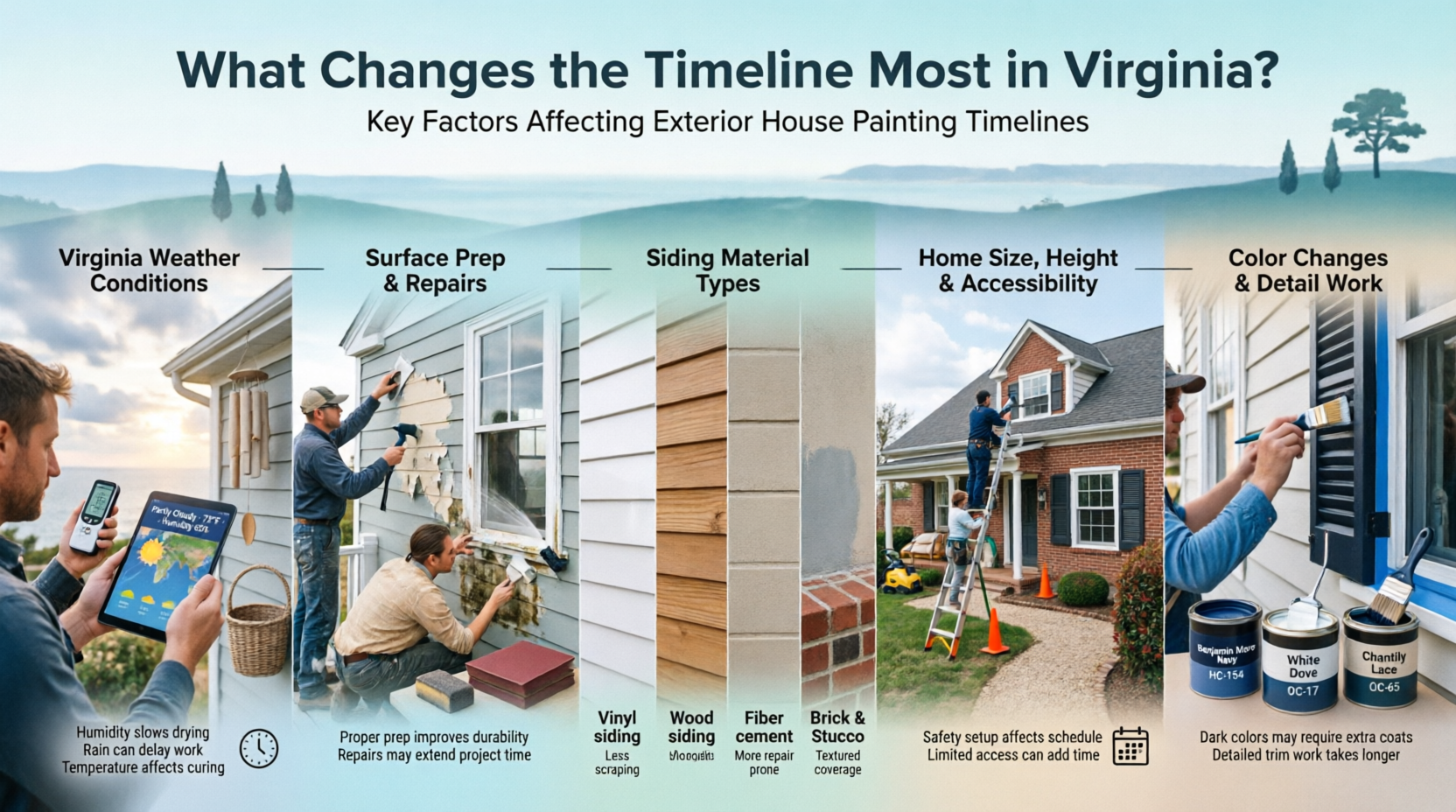
What Changes the Timeline Most in Virginia?
If you want the most accurate answer to “how long does an exterior paint job take in Virginia,” you have to look at the factors that push the schedule shorter or longer. In our experience, these are the biggest ones.
Virginia Weather Windows (Humidity, Rain, and Temperature Swings)
Virginia coastal weather is the biggest wildcard for exterior painting schedules.
Humidity slows drying. Pop-up rain can interrupt a workday. Summer storms can roll in quickly. And in spring and fall, you can get temperature swings that change what’s safe to apply and when.
Here’s what that means in real life. Even if it’s not raining right now, we have to think about whether surfaces will stay dry long enough for paint to set up properly. We also pay attention to overnight temperatures, because paint products have recommended ranges for application and curing. Following those guidelines is how you get a finish that lasts.
If you’re near the water like in Virginia Beach or parts of Norfolk, salty air can be tougher on exterior surfaces over time. That doesn’t always make the project longer, but it does make prep and product choice more important, especially on older coatings.
In general, the “sweet spot” seasons are usually spring and fall, when temperatures are moderate and the weather is more stable. Summer can still be a great time to paint, but it’s also when humidity and storm delays are more common.
Surface Prep and Repairs (Rot, Peeling, Chalking, and Caulk Failure)
Prep is the step that protects your investment. It’s also one of the biggest timeline drivers.
If your home has peeling paint, chalking, cracked caulk, or soft wood, the schedule grows because we have to fix the surface before paint can do its job. Paint isn’t a patch for damage. It’s a finish coat that needs a stable base.
Across Chesapeake exterior painting and Suffolk exterior painting projects, we often see:
Peeling paint on older trim and wood features
Wood rot around windows, doors, fascia, and soffits
Chalking on sun-exposed sides of the home
Failed caulk lines where moisture has been getting in
Mildew on shaded or north-facing walls after humid stretches
Those issues don’t always mean a “big” repair, but they do mean the timeline needs to include the right steps. And if repairs are needed, it’s usually better to handle them now than to paint over them and watch the finish fail early.
Siding Type (Vinyl vs Wood vs Fiber Cement vs Brick/Stucco)
When homeowners ask, “how long does it take to paint siding,” the honest answer is that the material changes the pace.
Vinyl siding can sometimes move faster because it often has less scraping than older wood. But it still needs proper cleaning, and it needs the right paint system to bond well. Vinyl also has limitations around going much darker, because heat can cause warping.
Wood siding usually takes longer. Wood expands and contracts, can hide rot, and often has more peeling. Prep is typically heavier, and repairs are more common.
Fiber cement is often a great painting surface, but it still needs careful prep and caulking at joints. It can be efficient to paint, but trim and detail work still add time.
Brick and stucco can take longer to coat evenly because of texture. If it’s unpainted brick, it may need specific prep and priming steps. If it’s already painted brick, we’re often dealing with older coatings that may be chalking or failing.
So when you’re thinking about your exterior house painting timeline, don’t just think “house size.” Think “surface type + surface condition.”
Home Size, Height, Access, and Landscaping
Two homes can be the same square footage and still have very different timelines.
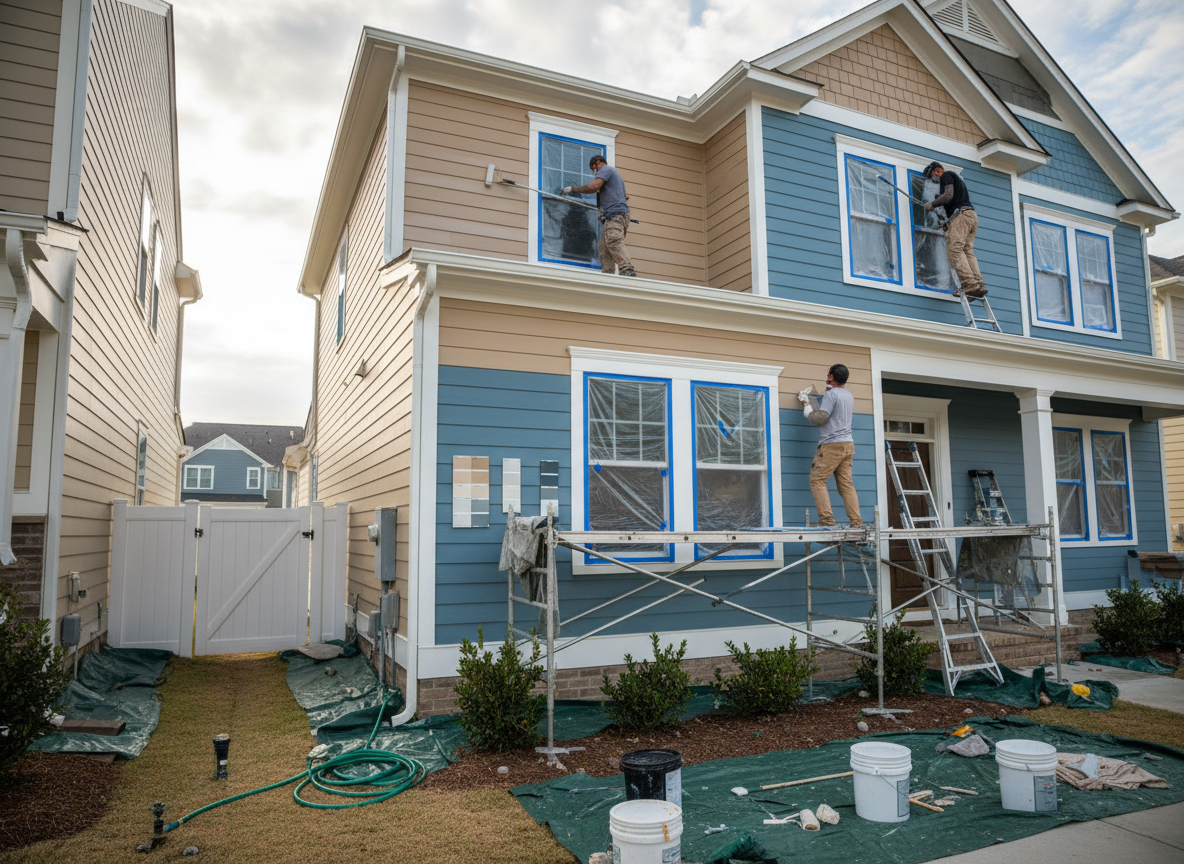
A two-story home takes longer than a one-story home because ladder work and safety setup take time. Homes with steep rooflines, tight side yards, or limited access can add time too.
Landscaping matters more than most people realize. If shrubs are tight against the siding, we can protect them, but it slows movement and makes painting more careful. If you want to help the timeline, giving us some space around the home is one of the best things you can do.
Color Changes and Detail Work
More colors usually means more time.
Big color changes can require extra priming or extra coats for full coverage. And the more detailed work you have—trim, shutters, doors, porch features, the more time it takes to do it cleanly.
If you’re aiming for a clean, high-end look, this is the section where you don’t want anyone rushing. Crisp lines and even coverage are worth the extra day.
What a “Fast Paint Job” Usually Skips (And Why That’s Risky)
Everyone loves a quick turnaround. We do too. But there’s a difference between efficient and rushed.
A fast paint job often skips the steps that make paint last. And those skipped steps are usually why homeowners end up repainting sooner than they expected.
Common shortcuts include skipping thorough washing, doing minimal scraping and sanding, painting over failed caulk, skipping primer where it’s needed, or rushing dry time between coats. Those choices can lead to peeling, bubbling, uneven sheen, or early cracking especially in Virginia’s humidity.
We’d rather give you a realistic exterior painting time estimate and deliver a finish that holds up than promise a timeline that only works if we cut corners.
If you want to learn more about how we approach quality and accountability, you can also review our money-back guarantee, it’s part of how we keep expectations clear from day one.
How to Plan Your Week Around an Exterior Paint Project
A good paint crew will do the heavy lifting. But a little planning on your side can make the week feel a lot easier. It can also prevent small hiccups that slow the schedule down.
First, think about access. We’ll need room to move ladders, set up materials, and reach all sides of the home. If you normally park close to the house, plan to shift vehicles to the street or farther down the driveway during work hours. In tighter neighborhoods, common in parts of Norfolk and Virginia Beach, this one simple change can keep the project moving.
Next, plan for outdoor items. Patio furniture, grills, kids’ toys, and potted plants near the house should be moved back if possible. We can help protect things, but the more space we have, the faster and cleaner the work goes. The same goes for shrubs. If you can trim them back a bit or tie them away from the siding, it helps us paint more efficiently and reduces the risk of rubbing against wet paint.
If you have pets, we recommend keeping them inside during the day. Doors may be opened and closed more often, and you don’t want a curious dog brushing against a ladder or a freshly painted corner. For kids, the main thing is setting expectations. The outside of the home becomes a work zone for a few days, and it’s best to keep play areas away from the walls.
Two more timeline-savers that homeowners don’t always think about are sprinklers and color choices. If your irrigation system hits the house, turn it off or adjust it for the week. Water on siding can delay painting, especially in humid weather. And if you haven’t finalized colors, do it early. Waiting until the crew is on site can pause progress, especially if you’re coordinating with an HOA.
If you’re also planning other work like updating interior spaces while the exterior is being refreshed, our interior house painters service can be a good companion project, but we’ll help you plan so schedules don’t overlap in a stressful way.
Timeline Expectations by Home Type (Typical Exterior Painting Timeline in Virginia)
Most homeowners want a simple answer: “How many days should I plan for?” The best way to do that is to look at typical home types and what usually slows them down.
Before you read the table, keep one thing in mind. These are working-day ranges for a professional crew under normal conditions. Weather delays (rain, high humidity, temperature drops) can add time, and repair-heavy homes can add time too. But this should give you a realistic exterior house painting timeline to start with.
Typical Exterior Painting Timeline (Virginia)
| Home size / complexity | Prep time range | Paint time range | Total project range | What usually causes delays |
|---|---|---|---|---|
| Small 1-story (simple layout, light trim) | 1–2 days | 1–2 days | 3–4 days | Rain/humidity, surprise peeling, tight landscaping |
| Average 2-story (standard trim, typical wear) | 2–3 days | 2–3 days | 5–7 days | Extra prep on shaded sides, caulk/wood repairs, multi-color details |
| Large/complex (3-story, lots of trim, difficult access) | 3–5 days | 3–5 days | 7–10+ days | Access challenges, heavy repairs, extended dry times, detailed trim/porches |
This is why the question “how long does it take to paint the exterior of a house” doesn’t have one universal number. A straightforward one-story home might be done in under a week. A larger home with lots of detail can take longer, even with a strong crew, because the work is more precise and the prep is heavier.
If you’re in a coastal area like Virginia Beach, you may also see more mildew-prone sides of the home, which can increase cleaning and prep needs. In inland pockets or more open areas around Suffolk, airflow can sometimes help drying, but weather still matters across the whole region.
If you’re looking for a local team that handles these variables every day, you can learn more about how we approach exterior projects on our house painters page, and see local service details for Virginia Beach exterior painting and Norfolk exterior painting.
Factors That Change the Schedule (What Impacts the Timeline Most?)
Now let’s get even more practical. If you want to tighten your exterior painting time estimate, focus on the factors below. These are the things that most often move a project from the shorter end of the range to the longer end.
The good news is that some of these are within your control. Others aren’t (we can’t change the weather), but we can plan around them.
What Impacts the Timeline Most?
| Factor | How it affects the schedule | What homeowners can do to help |
|---|---|---|
| Weather (rain, humidity, temperature swings) | Can pause work, extend dry time, and shift coat timing | Build flexibility into the week; avoid scheduling big outdoor events mid-project |
| Prep level needed (peeling, chalking, mildew) | More scraping/sanding/cleaning adds days but improves durability | Share any known problem areas; don’t pressure anyone to “skip prep” |
| Siding type (vinyl/wood/fiber cement/brick) | Some surfaces need more prep, different primers, or more careful application | Tell us what siding you have; mention any past paint failures |
| Repairs (wood rot, loose trim, cracks) | Repairs can add time but prevent early paint failure | Approve repair recommendations quickly so the schedule doesn’t stall |
| Number of colors + detail work | More masking and cut lines increases labor time | Confirm colors early; keep the scheme simple if speed is the priority |
| Accessibility (height, steep rooflines, tight side yards) | Slower movement and more safety setup | Unlock gates; clear side yards; move vehicles for staging |
| Landscaping close to the home | Slows access and increases protection needs | Trim shrubs back; move planters and décor away from siding |
| Dry time between coats | High humidity or shade can extend the time needed between steps | Keep sprinklers off; avoid washing the exterior during the project |
If you read that table and think, “Okay, I can help with a few of those,” you’re exactly right. Clearing access, confirming colors early, and managing sprinklers are small changes that can make a real difference without cutting corners.
And if you’re planning other painting work at the same time like a business space refresh, our commercial painting company team can help coordinate timelines so you’re not juggling multiple contractors at once.
FAQs About Exterior Painting Timelines in Virginia
How long does it take to paint the exterior of an average 2-story home in Virginia?
For an average two-story home in Virginia, most professional projects land in the 5 to 7 working day range, assuming normal prep and no major repairs. The reason it’s rarely “just a couple days” is that the schedule includes washing, drying time, scraping and sanding where needed, caulking, priming, and then painting both siding and trim. In places like Virginia Beach and Norfolk, humidity and pop-up rain can also stretch dry times, especially on shaded sides of the home. If the home has heavy peeling, lots of detailed trim, or you’re making a big color change, it can push closer to a full week or a bit beyond.
What time of year is fastest for exterior painting in Virginia?
In most years, spring and fall are the fastest seasons for exterior painting in Virginia because temperatures are moderate and weather patterns are often more stable. You’re less likely to deal with extreme humidity or daily storm chances, and paint tends to dry and cure more predictably. Summer can still be a great time to paint, but it’s also when humidity and afternoon storms can cause schedule adjustments. Winter can work on the right days, but temperature swings and cold nights can limit the safe painting window, which can slow the overall pace.
Does humidity slow down exterior paint drying time?
Yes, humidity can slow down drying time in a very real way, and it’s one of the biggest reasons exterior painting schedules vary in coastal Virginia. When the air is already holding a lot of moisture, paint can take longer to release solvents and set up properly, especially in shaded areas or on surfaces that don’t get much airflow. That doesn’t mean the job can’t be done, it just means we may need longer gaps between coats or we may shift which sides of the home we paint first. In Virginia Beach and other near-coast areas, humidity is a normal part of planning a realistic exterior house painting timeline.
How long after pressure washing can you paint?
Most homes need at least 24 hours after pressure washing before painting, but in Virginia’s humidity it can be longer, sometimes 48 hours or more, depending on the surface, shade, and airflow. The goal is simple: the siding and trim need to be dry enough for paint to bond correctly. Painting over damp surfaces can trap moisture and lead to peeling or bubbling later. If you’re trying to plan a tight week, it helps to understand that washing is often the easy part; drying is what can quietly extend the schedule.
How long does prep work take compared to painting?
Prep work often takes as long as painting, or longer, especially on older homes or homes with peeling paint, chalking, or failing caulk. Homeowners sometimes expect the “painting” to be the main event, but the truth is that scraping, sanding, repairs, and priming are what make the finish last. On a well-maintained home, prep might be a day or two. In a home with heavier wear, prep can take several days. If you want a paint job that holds up through Virginia weather, prep isn’t the place to rush.
Can you paint if rain is in the forecast?
Sometimes yes, sometimes no, and it depends on timing and how much rain is expected. If rain is likely during the window when paint needs to be set up, it’s usually smarter to pause or shift the schedule rather than risk washing fresh paint off the surface or trapping moisture. In Virginia, pop-up storms can happen quickly in summer, and coastal weather can change fast. A professional crew will watch the forecast closely and plan the order of work like focusing on protected sides of the home first, so the project stays safe and the finish stays durable.
How long does exterior paint need to cure before it’s “fully durable”?
Exterior paint can feel dry within hours, but full curing typically takes days to a few weeks, depending on the product and weather conditions. “Dry” means you can touch it lightly without it feeling tacky. “Cured” means the paint film has hardened and reached its full durability, which matters for washing, heavy contact, and long-term performance. In humid Virginia weather, curing can take longer than homeowners expect, even if the paint looks finished. We’ll guide you on what’s safe right away and what to avoid for the first couple of weeks so the finish stays strong.
Will my timeline be different in Virginia Beach vs inland areas?
It can be, but usually in small, practical ways rather than dramatic differences. In Virginia Beach and some parts of Norfolk, higher humidity and salty air can increase mildew risk and surface buildup, which can mean more thorough cleaning and sometimes more prep on certain sides of the home. Inland areas may have slightly different airflow and drying conditions, but rain and temperature swings still affect the whole region. The bigger driver is still your home’s condition and complexity, but location can influence how we plan the workday-by-day.
How do repairs (wood rot, peeling paint) affect the schedule?
Repairs can add time, but they also protect you from paying for the same paint job twice. If we find wood rot, loose trim, deep cracks, or heavy peeling, we need to address those issues before paint goes on, otherwise the finish may fail early. Even small repairs can add a day because they often come with extra prep, priming, and dry time. The upside is that once repairs are handled correctly, the paint system can bond to a stable surface and hold up better through Virginia humidity, rain, and sun.
How long does it take to paint siding (vinyl, wood, fiber cement, or brick)?
The timeline depends on both the material and the condition. Vinyl can be efficient if it’s in good shape, but it still needs proper cleaning and the right coating for adhesion, and color changes can require extra planning. Wood often takes longer because it’s more likely to need scraping, sanding, and repairs. Fiber cement can be a great surface to paint, but joints and trim details still take time. Brick and stucco can take longer to coat evenly because of texture and the prep/priming needs, especially if older coatings are failing. If you tell us your siding type and what you’re seeing (peeling, chalking, mildew), we can give a much tighter exterior painting time estimate.
How can I help the painters finish faster without cutting corners?
The best way to help is to remove obstacles and reduce decision delays. Clear vehicles from the work area, unlock gates, move outdoor furniture and planters away from the house, and trim shrubs back from the siding if you can. Turn off or adjust sprinklers so water isn’t hitting the home. Confirm colors early, and if you have HOA approval needs, start that process before the crew arrives. None of those steps reduce quality. They simply remove friction so the crew can focus on prep and painting instead of working around avoidable delays.
Get a Clear Timeline for Your Home (Without Guessing)
So, how long does an exterior paint job take in Virginia? For most homes, plan on 3 to 7 working days, with the understanding that prep needs, repairs, and Virginia weather can move the schedule a bit.
If you’re in Virginia Beach, Norfolk, Chesapeake, Suffolk, or surrounding areas, we’re happy to help you get a realistic timeline based on your home’s size, siding type, and condition. You can learn more about what we include on our exterior house painting page, or explore our local service pages for Chesapeake and Suffolk. If you’re nearby in places like Portsmouth, Smithfield, Carrollton, Yorktown, or Williamsburg, chances are we can help there too, just ask and we’ll confirm scheduling.
When you’re ready, reach out for a timeline estimate. We’ll walk the home, talk through prep and any repairs, and give you a plan that fits your week and your goals, no pressure, just clear expectations.